04 Oct 2026how to check if korean skincare is authentichow to spot fake korean skincarehow to verify skincare batch codessigns of counterfeit skincare productsspot fake korean skincarewhat to do if you bought counterfeit skincareBeauty-Blog über Hautpflege- und Self-Care-Trends
Fake Korean skincare products flood online marketplaces every day. They look nearly identical to the real thing. But they damage your skin, waste your money, and undermine the brands you trust. Spotting counterfeits is one of the most common concerns we hear.
Counterfeit skincare isn't just a minor inconvenience. Fake products often contain harmful ingredients, incorrect concentrations, or no active ingredients at all. Some counterfeits use dangerous fillers or banned substances that can trigger allergic reactions, irritation, or long-term skin damage.
The problem is widespread. Major online retailers, marketplace sellers, and even some beauty shops unknowingly stock counterfeits. The best protection is learning how to spot fake Korean skincare yourself before you buy.
Visual Red Flags: How to Spot Fake Korean Skincare at First Glance
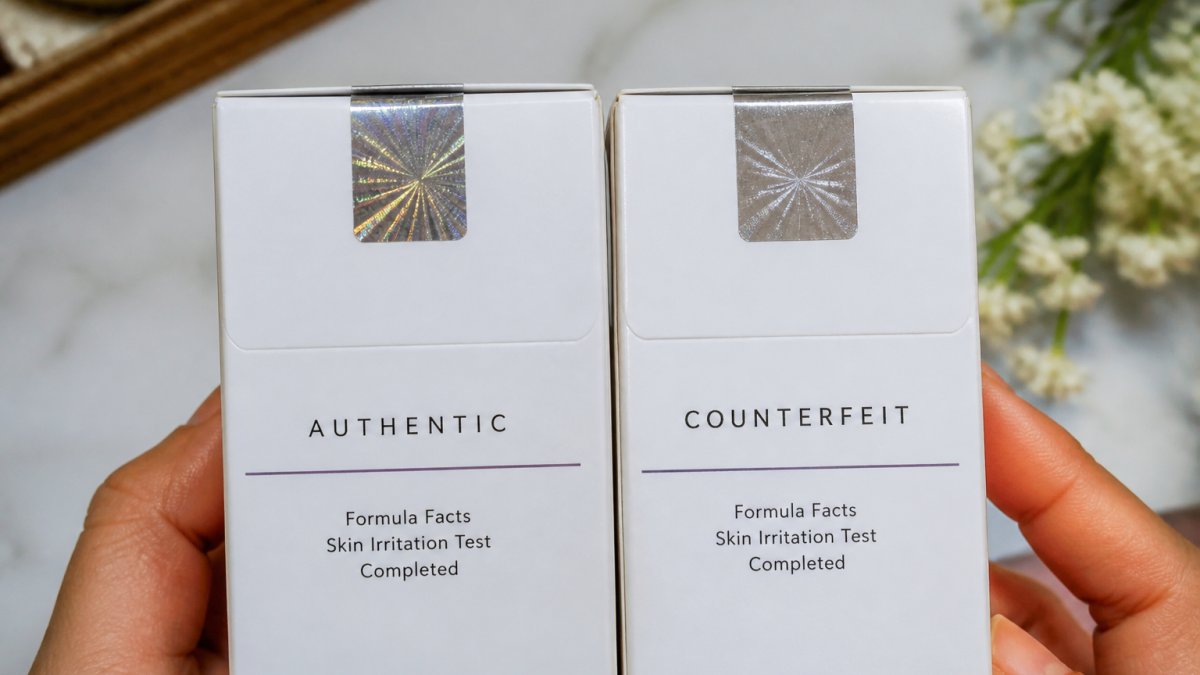
Close-up of authentic Korean skincare product packaging next to counterfeit version showing clear differences in print quality, label alignment, and holographic seal details under bright lighting
Authentic Korean skincare has distinctive packaging. Counterfeiters work hard to copy it, but they almost always miss details. These visual differences are your first defense when learning how to spot fake Korean skincare.
Packaging quality and printing
Real Korean skincare uses high-quality printing with sharp, crisp text and images. The colors are vibrant and consistent. Counterfeit packaging shows blurry text, uneven color saturation, or misaligned labels.
Check these packaging details:
Text sharpness: Real products have razor-sharp lettering. Fakes often look slightly blurry or pixelated.
Color consistency: Authentic packaging maintains uniform color across the entire surface. Counterfeits may show fading or color shifts.
Label alignment: Legitimate products have perfectly centered labels. Fakes often have labels that sit crooked or off-center.
Holographic elements: Many Korean brands use holographic seals or stickers. Counterfeits use cheap imitations that lack the shimmer or depth of real holograms.
Embossing and texture: Feel the packaging. Real Korean skincare often has subtle embossed text or textured elements. Fakes feel flat and cheap.
Ingredient list and labeling inconsistencies
The ingredient list is where counterfeits frequently fail. Real Korean skincare lists ingredients in the correct order and uses proper chemical names.
Watch for these red flags:
Ingredient order changes: If you've bought the same product before, compare ingredient lists. They should be identical. Fakes often rearrange ingredients or swap them out entirely.
Spelling errors: Legitimate brands don't misspell ingredient names. If you see "Hyaluronic Acid" spelled as "Hyaluranic Acid," that's a counterfeit.
Missing information: Real products list the country of manufacture, batch code, and expiration date clearly. Counterfeits often omit or obscure this information.
Font inconsistencies: The font used for ingredient lists should match the rest of the packaging. Fakes often use a different font that looks out of place.
Language mixing: Korean brands typically use both Korean and English on packaging, but the quality of translation is professional. Counterfeits show awkward phrasing or grammar errors.
Signs of Counterfeit Skincare Products You Can't Ignore
Beyond packaging, the product itself tells you whether it's authentic. These signs reveal fake Korean skincare immediately.
Texture, smell and formula oddities
Open the product and use your senses. Authentic Korean skincare has a specific texture and scent for each formula type.
Red flags include:
Unusual texture: Serums should feel lightweight and absorb quickly. If a serum feels sticky or leaves a residue, it's likely counterfeit. Moisturizers should have a smooth, creamy consistency without graininess.
Off smell: Real Korean skincare has a clean, subtle scent (or no scent at all for unscented formulas). Counterfeits often smell chemical, overly sweet, or rancid.
Separation or settling: If the product has separated into layers or shows visible settling after sitting, the formulation is unstable. Legitimate products remain uniform.
Discoloration: Authentic products maintain consistent color. Fakes may show browning, yellowing, or unexpected color changes.
Expired ingredients: Some counterfeits use old or degraded ingredient batches. The formula may feel thin, watery, or ineffective.
Pricing that seems too good to be true
If the price feels dramatically lower than everywhere else, it probably is. Real Korean skincare has consistent pricing across authorized retailers. Deep discounts often signal counterfeits.
Unusually low prices: Authentic Korean skincare from trusted brands rarely sells for 50% below retail. If a product costs half the normal price, question it.
Inconsistent pricing across sellers: Compare prices on multiple authorized retailers. Legitimate products have similar pricing. If one seller is drastically cheaper, they may be selling fakes.
Bulk discounts that don't make sense: Real brands offer modest discounts for bulk purchases. Counterfeits offer extreme bulk discounts to move inventory quickly.
Flash sales from unknown sellers: Be cautious of sudden, massive sales from marketplace sellers with no history. Legitimate brands control their own promotional calendars.
How to Check if Korean Skincare Is Authentic Through Batch Codes
Batch codes are your most reliable tool for verifying authenticity. Every legitimate Korean skincare product has a unique batch code that tracks when and where it was made.
Locating and reading batch codes
Batch codes appear in different places depending on the brand. Most Korean skincare prints the batch code on the back label, the bottom of the container, or inside the jar lid.
Here's how to find and read batch codes:
Look on the back label: Many brands print the batch code in small text near the bottom or side of the back label.
Check the bottom: Some products have the batch code stamped or printed on the container's bottom.
Inside the lid: For jars and containers with lids, the batch code may be printed inside the lid itself.
Format: Batch codes typically consist of letters and numbers (e.g., "2024-07-15A" or "240715A"). The first digits usually represent the year and month of manufacture.
Write down the batch code exactly as it appears. You'll need it to verify authenticity through the manufacturer's system.
Using manufacturer verification tools
Most major Korean skincare brands offer batch code verification tools on their official websites. This is the gold standard for confirming authenticity.
Follow these steps:
Visit the brand's official website: Go directly to the brand's global or regional site. Never use a third-party verification site.
Find the authentication tool: Look for a "Verify Authenticity," "Check Batch Code," or "Product Authentication" section. It's usually in the customer service or FAQ area.
Enter the batch code: Input your batch code exactly as it appears on the product.
Check the result: The system will tell you whether the batch code is registered, when the product was manufactured, and where it was distributed.
Note the distribution region: Legitimate batch codes show the intended market. If a product was manufactured for the Korean market but you bought it from a seller claiming it's a U.S. exclusive, something's wrong.
If the batch code doesn't verify, or if the website says the code is invalid, you have a counterfeit.
How to Verify Skincare Batch Codes and Serial Numbers
Some Korean skincare brands use serial numbers in addition to batch codes. These provide an extra layer of authentication. Serial numbers are unique to each individual product unit.
Serial numbers typically appear as:
A QR code you can scan with your phone
A holographic sticker with printed numbers
A unique code printed directly on the product
To verify a serial number:
Scan the QR code: If the product has a QR code, scan it with your phone camera. It should direct you to an official verification page.
Enter the serial number on the brand's website: Some brands have a dedicated serial number verification tool. Input the number and the system will confirm authenticity.
Check for consistency: The serial number should match other product information (batch code, manufacturing date, distribution region).
If a QR code doesn't work, or if scanning it takes you to a suspicious website, the product is fake. Legitimate Korean brands use secure QR codes that direct to verified, official pages.
The safest way to avoid counterfeits is buying from authorized retailers. Not all online sellers are legitimate, even on major platforms.
Trusted sources for authentic Korean skincare include:
Official brand websites: Direct-to-consumer sites are your safest bet. You're buying straight from the source.
Authorized beauty retailers: Major authorized sellers include Sephora, Ulta, and other established beauty retailers that verify their suppliers.
Specialized K-beauty retailers: Established K-beauty retailers with strong reputations and customer reviews are generally reliable.
Beautivana: We curate authentic Korean skincare from trusted brands and ship fast throughout the U.S. Our Beautivana 4-Step Natural Skincare Set includes verified authentic products like our Mung Bean Gentle Foaming Cleanser and Snail Mucin 92% Moisturizer, both sourced directly and backed by our authenticity guarantee.
Avoid these red flags when shopping:
Beautivana Snail Mucin 92% Moisturizer – Hydrating Face Cream, 1.76 oz
Beautivana 4-Step Natural Skincare Set for Daily Care
Unverified marketplace sellers: Sellers with no reviews or a short history are higher risk.
Suspiciously cheap prices: If it's significantly cheaper than everywhere else, it's likely counterfeit.
Sellers outside the U.S.: International sellers sometimes ship counterfeits. Stick with U.S.-based retailers when possible.
Sellers with vague product descriptions: Legitimate retailers provide detailed product information and ingredient lists.
What to Do If You Bought Counterfeit Skincare
If you've already purchased a fake product, don't panic. You have options.
Here's what to do:
Stop using it immediately: Discontinue use right away to prevent skin irritation or damage.
Document everything: Take photos of the packaging, ingredient list, batch code, and any signs of counterfeiting. Keep your purchase receipt and any seller communications.
Contact the seller: Report the counterfeit to the marketplace or seller. Most platforms have buyer protection policies. File a claim for a refund or replacement.
Report to the brand: Contact the legitimate brand directly. Provide your photos and batch code. Most brands take counterfeiting seriously and appreciate reports.
Report to authorities: For significant purchases or repeated counterfeiting, you can report to the Federal Trade Commission (FTC) at FTC's consumer complaint database. This helps track counterfeit networks.
Monitor your skin: If you experienced irritation or unusual reactions, track your symptoms. If problems persist, consult a dermatologist.
Most authorized retailers offer return policies for damaged or counterfeit products. We stand behind every item we ship, and if you receive anything that doesn't meet our authenticity standards, we'll make it right.
Learning how to spot fake Korean skincare protects your skin and your investment. Counterfeit products can damage your complexion and waste your money. The good news: armed with these verification tools, batch code checks, and trusted retailers, you can shop with confidence. At Beautivana, we're committed to delivering authentic Korean skincare that delivers visible results. Every product we offer comes with fast U.S. shipping and our commitment to quality.
Frequently Asked Questions
How can you tell if Korean skincare is fake?
Check for blurry or misaligned printing on the package, misspelled ingredient names, and inconsistent font sizes. Authentic Korean skincare has sharp, precise labeling. Examine the product texture and smell, counterfeits often have an off odor or separated formula. Verify the batch code through the manufacturer's website or use a batch code checker app. Buy only from authorized retailers to ensure you receive genuine products with proper documentation and authenticity guarantees.
What are the signs of counterfeit skincare products?
Common red flags include poor packaging quality, spelling errors on labels, inconsistent ingredient lists compared to the brand's official website, and unusually low prices. Counterfeit products may have a strange texture, separation, or off-putting smell. The batch code may be missing, faded, or unverifiable on the manufacturer's database. Check the seal integrity, authentic Korean skincare typically has tamper-evident seals. When in doubt, purchase from trusted retailers that source directly from verified distributors.
Can you check a Korean skincare product's batch code online?
Yes. Most Korean beauty brands allow you to verify batch codes through their official websites or dedicated verification apps. The batch code format varies by brand but typically appears as a combination of letters and numbers printed on the packaging. Visit the brand's official site, find the authentication or batch code verification tool, and enter your code. If the code doesn't match any records or shows an invalid format, the product is likely counterfeit.
What should I do if I think my skincare product is counterfeit?
Stop using it immediately to avoid potential irritation from unverified ingredients. Contact the retailer where you purchased it with photos of the packaging and batch code. Request a refund or replacement. If you bought from an unauthorized marketplace, report the seller to the platform. Document everything, photos, order confirmations, and correspondence. File a complaint with the brand's customer service. For future purchases, buy from authorized retailers, which guarantees authentic Korean skincare with proper sourcing and quality control.