

Last Updated: September 16, 2026
Korean skincare and Japanese skincare differ most in philosophy: K-beauty treats skin as something to hydrate, layer, and glow, while J-beauty treats it as something to protect, refine, and simplify. That single split shapes everything from cleansing to anti-aging. At Beautivana, we see this play out daily among customers in Atlanta and across the U.S. who want glass skin without guessing which tradition to follow.
The short version:
Neither is better. They solve different problems, and the right pick depends on your skin's behavior, not the hashtag.
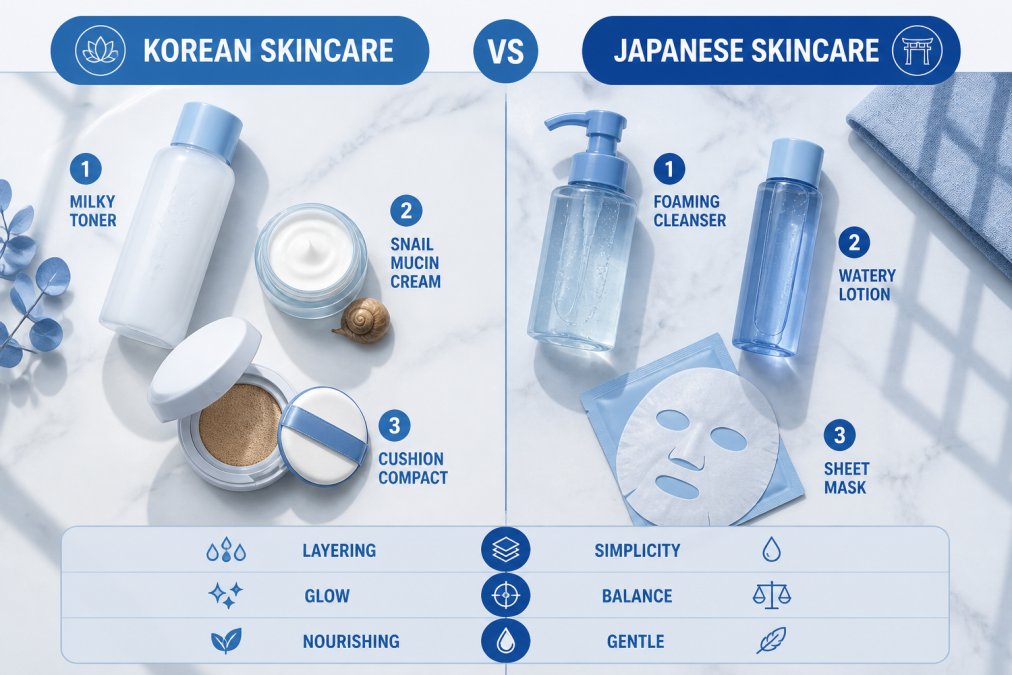
Korean cleansing typically starts with an oil-based balm or cleanser to break down sunscreen and makeup, followed by a water-based second cleanse. Japanese routines often lead with a dense foam, whipped by hand or with a net, so the cleanser never drags across the skin.
A common mistake is skipping the oil step in a Korean routine and wondering why texture never improves. The oil phase does the heavy lifting; the second cleanse just finishes the job.
If your skin leans dry or reactive, a non-stripping formula matters more than the ritual itself. Beautivana's Non-Drying Glycerin Cleanser uses a 50% glycerin base with aloe vera and centella asiatica, so it works as either a second cleanse or a standalone morning wash. For a gentler, water-activated option, the Clean Rice Enzyme Powder Wash activates with water and lifts surface buildup without a harsh scrub feel.


Korean hydration is about stacking thin layers: toner, essence, ampoule, serum, cream. Japanese hydration often compresses into fewer, more concentrated steps, with watery lotions applied by hand and sealed under a sheet mask or milky emulsion.
Beautivana Clean Rice Enzyme Powder →
The practical difference is time. A full Korean layering routine can take ten minutes; a Japanese routine can be done in three. For busy mornings, fewer layers win. For evening recovery, layering gives you more control over how much moisture each zone receives.
Milky toners sit at the center of both traditions. Beautivana's PDRN Pink Milky Hydrating Toner is a lightweight first layer that preps skin for serum, and it fits a Japanese-style short routine as easily as a Korean seven-step one.
The benefits of fermented ingredients in skincare come down to how fermentation pre-breaks down large molecules into smaller ones, which many formulators find easier for skin to absorb. Fermented rice, soy, and yeast filtrates appear in both Korean and Japanese products, though Korea built its modern identity around them first.
What most guides miss: fermentation is a processing method, not a magic ingredient. A fermented rice extract in a poorly formulated cream still underperforms a simple, well-balanced moisturizer. Judge the finished formula, not the fermentation claim on the front of the box.
Learning how to build an Asian skincare routine that mixes both traditions is mostly about matching step count to your skin's tolerance. Start with the Japanese principle of fewer, better steps, then add Korean layering only where your skin feels tight or dull.
A workable hybrid:
Beautivana's Snail Mucin 92% Moisturizer is formulated with 92% snail secretion filtrate and spreads easily, which makes it a reasonable last step for combination skin that resists heavy creams. If you want the whole sequence in one box, the Premium Diamond Gold Korean Skincare Set bundles a coordinated multi-step routine for at-home use.

| Routine Style | Steps | Best For | Time |
|---|---|---|---|
| Korean layering | 6-10 | Dry, dull, dehydrated skin | 8-12 min |
| Japanese minimal | 3-5 | Oily, sensitive, reactive skin | 3-5 min |
| Hybrid | 4-6 | Most skin types | 5-7 min |
Finish is the fastest way to tell which tradition suits you. Korean skincare chases a dewy, reflective surface; Japanese skincare chases a soft, even, matte-leaning finish that photographs cleanly and layers well under makeup.
Beautivana Clean Rice Enzyme Powder →
Anti-aging priorities diverge too. Korean routines lean on hydration, barrier support, and brightening actives like vitamin C and niacinamide. Japanese routines historically emphasize UV protection and gentle exfoliation, on the logic that most visible aging is sun-driven.
For shoppers in Atlanta searching for Korean skincare near me, the deciding question is simple: do you want glow or polish? If your skin is dry and looks tired, Korean layering delivers more visible change. If your skin is oily, reactive, or breaks out easily, the Japanese discipline of fewer steps and steady sun protection will do more for you.
Choosing between these two traditions is less about which country does skincare better and more about which rhythm your skin will actually tolerate for six months. Beautivana carries spa-inspired Korean skincare, advanced at-home beauty devices, and luxury fragrance, with fast U.S. shipping and a curated range built for exactly this kind of routine building. Start with a cleanser, a milky toner, and one moisturizer, then add devices and treatments once the basics hold. Get started with Beautivana and build a routine that fits your skin, not a trend cycle.
Korean routines tend to layer many lightweight hydrating steps, while Japanese routines favor fewer, highly textured products and a foam-first cleanse. Korean formulas often feature snail mucin, PDRN, and fermented extracts; Japanese formulas rely on rice bran, green tea, and camellia oil. Neither is better, they simply prioritize different outcomes: K-beauty chases a dewy glow, J-beauty chases refined skin texture and calm.
Japanese skincare often suits sensitive skin because its routines use fewer steps and gentle foaming cleansers. Korean skincare can also work if you skip exfoliating acids and stick to barrier-friendly ingredients like centella asiatica and glycerin. A non-drying glycerin cleanser with aloe vera and oat is a practical starting point for reactive skin in either approach, and patch testing one new product at a time is still the safest path.
Yes, and most people already do. A simple hybrid keeps a Japanese foam or oil cleanse, adds a Korean milky toner and snail mucin moisturizer, then finishes with sunscreen. The order stays the same: cleanse, tone, treat, moisturize, protect. Introduce one new product every one to two weeks so you can tell what is actually helping and what is causing irritation.
Hydration and comfort usually show up within one to two weeks. Texture, tone, and firmness typically take six to twelve weeks of consistent use, which matches the skin's renewal cycle. Photograph your skin in the same lighting every two weeks so progress is easier to judge than by memory. If nothing changes after three months of steady use, simplify the routine before adding more products.