Korean skincare has revolutionized how people with sensitive skin approach their daily routines. The philosophy behind these products differs fundamentally from Western approaches: rather than stripping and treating, Korean formulations focus on hydration, barrier support, and gentle active ingredients that work with your skin instead of against it. If you've struggled with redness, irritation, or reactive skin, understanding how to treat sensitive skin with Korean products can transform your results.
At Beautivana, we've curated a selection of spa-inspired Korean skincare specifically designed for reactive and delicate complexions. The key difference isn't just the ingredients, it's the entire system. Korean skincare routines layer lightweight products that build protection and hydration, rather than relying on heavy creams or harsh actives. This guide walks you through exactly how to select, test, and use Korean products safely for sensitive skin.
Why Korean Skincare Works for Sensitive Skin
Korean skincare formulations prioritize hydration and barrier repair over aggressive treatment. This approach stems from a fundamentally different philosophy: sensitive skin needs support and nourishment, not correction. Most Western skincare treats sensitivity as a problem to solve with actives. Korean skincare treats it as a condition requiring patience and layered hydration.
The formulations reflect this. Korean brands invest heavily in humectants like hyaluronic acid, glycerin, and panthenol that draw moisture into the skin. They use soothing botanicals such as Centella Asiatica (cica), green tea, and snail mucin that calm inflammation without irritation. Crucially, they avoid high concentrations of common irritants, most Korean serums and toners contain lower percentages of actives than their Western counterparts, making them gentler for reactive skin.
The layering system itself is protective. By applying multiple lightweight products, you build hydration gradually and allow each layer to absorb fully. This prevents the overwhelming sensation that can trigger sensitivity. A person using Western skincare might apply one heavy moisturizer; someone following a Korean routine applies a hydrating toner, essence, serum, and lightweight moisturizer. Each step delivers specific benefits without overloading the skin barrier.
Beautivana Ceramide Skin Barrier Moisturizer – 80 mL
Beautivana's curated collection reflects this philosophy. Products like the Beautivana Asiatica Daily Skincare Set feature Centella Asiatica as a core ingredient, a botanical known for supporting skin comfort and hydration. The lightweight formulation allows sensitive skin to absorb benefits without irritation.
Beautivana Asiatica Daily Skincare Set
Key Korean Ingredients That Soothe Sensitive Skin
Certain ingredients appear consistently in Korean skincare because they deliver results for sensitive skin without triggering reactions. Understanding these allows you to identify products that will actually work for your complexion.
Centella Asiatica (Cica) is the foundation of Korean sensitive skincare. This plant extract has been used in traditional medicine for centuries and appears in everything from toners to masks. It supports skin comfort, reduces the appearance of redness, and strengthens the skin barrier. Most Korean brands use it because it works without irritation, even people with extremely reactive skin tolerate cica well.
Panthenol (Vitamin B5) functions as both a humectant and a skin-conditioning agent. It draws moisture into the skin and helps repair the barrier. Korean formulations often use panthenol at higher concentrations than Western products, making it a reliable ingredient for sensitive skin. The Beautivana Panthenol + Centella Hydrating Mist combines both ingredients for maximum soothing effect.
Beautivana Panthenol + Centella Hydrating Mist – 3.38 fl oz
Hyaluronic Acid appears in nearly every Korean hydrating product. The ingredient holds up to 1000 times its weight in water, making it exceptionally effective for plumping and hydrating. Korean brands use multiple molecular weights, some penetrate deeper, others remain on the surface, creating comprehensive hydration without heaviness.
Niacinamide supports barrier function and reduces inflammation. Korean skincare uses niacinamide thoughtfully, typically at concentrations that soothe rather than stimulate. It pairs beautifully with hydrating ingredients and rarely triggers sensitivity.
Snail Mucin contains glycoproteins and hyaluronic acid that support hydration and skin repair. While it sounds unusual, it's one of the most effective ingredients for sensitive skin. It provides deep hydration without any irritation potential.
Ceramides are lipids that form the skin barrier. Korean moisturizers incorporate ceramides to repair compromised barriers and prevent moisture loss. The Beautivana Ceramide Skin Barrier Moisturizer uses ceramides alongside hyaluronic acid and panthenol for comprehensive barrier support.
Korean Skincare Patch Testing Guide for Sensitive Skin
Patch testing is non-negotiable when you have sensitive skin. Even gentle products can trigger reactions in certain individuals. The korean skincare patch testing guide approach ensures you identify potential irritants before applying products to your entire face.
Start by testing on the inner arm or behind the ear, areas with thin, sensitive skin that will show reactions quickly. Apply a small amount of the product and wait 24 hours. If no redness, itching, or burning occurs, proceed to a smaller facial test. Apply the product to a discrete area like your jawline or temple and use it for 3-5 days before expanding to your full routine.
Never introduce more than one new product per week. This allows you to identify exactly which product caused a reaction if one occurs. Many people with sensitive skin make the mistake of overhauling their routine at once, then having no idea which product triggered the problem.
Pay attention to timing. Some reactions appear within minutes; others develop over hours or days. Delayed reactions are common with sensitive skin. A product might feel fine on day one but cause redness by day three.
Document everything. Keep notes on which products you tested, when, and any reactions. Over time, you'll identify patterns, perhaps your skin reacts to certain preservatives, or specific botanical extracts. This information guides future purchases and helps you avoid repeating mistakes.
If a reaction occurs, stop using the product immediately and return to your baseline routine. Apply a soothing moisturizer like the Beautivana Ceramide Skin Barrier Moisturizer to calm inflammation. Wait until your skin returns to normal before testing another product.
Building Your Korean Skincare Routine for Sensitive Skin
A successful korean skincare routine for sensitive skin follows a specific sequence: cleanse, hydrate, treat, and protect. Each step builds on the previous one, creating comprehensive care without overwhelming your skin.
Cleansing is the foundation. Use a gentle, pH-balanced cleanser that removes impurities without stripping natural oils. Many Korean cleansers are formulated specifically for sensitive skin and avoid sulfates that can trigger irritation. Cleanse once daily at night; in the morning, simply rinse with lukewarm water.
Hydrating toner comes next. This isn't the astringent toner of Western skincare, Korean toners hydrate and prepare skin for serums. Apply with your hands or a cotton pad, gently pressing into skin. This step plumps the skin and creates an ideal base for subsequent products.
Essence is optional but beneficial for sensitive skin. Essences are lightweight, hydrating products that sit between toner and serum. They add an extra layer of moisture without heaviness.
Serum delivers concentrated actives and hydration. For sensitive skin, choose serums with soothing ingredients like cica, snail mucin, or niacinamide. Apply a few drops to damp skin and gently press in.
Sheet mask (1-2 times weekly) provides intensive hydration. Korean sheet masks are soaked in essence and deliver maximum hydration in 15-20 minutes. This step is especially helpful when your skin feels reactive or dehydrated.
Moisturizer seals everything in. Use a lightweight gel-cream or cream formulated for sensitive skin. The Beautivana Ceramide Skin Barrier Moisturizer provides lasting hydration while supporting barrier repair.
SPF (morning only) protects from sun damage, which can worsen sensitivity and redness. Use a mineral or hybrid sunscreen that won't irritate.
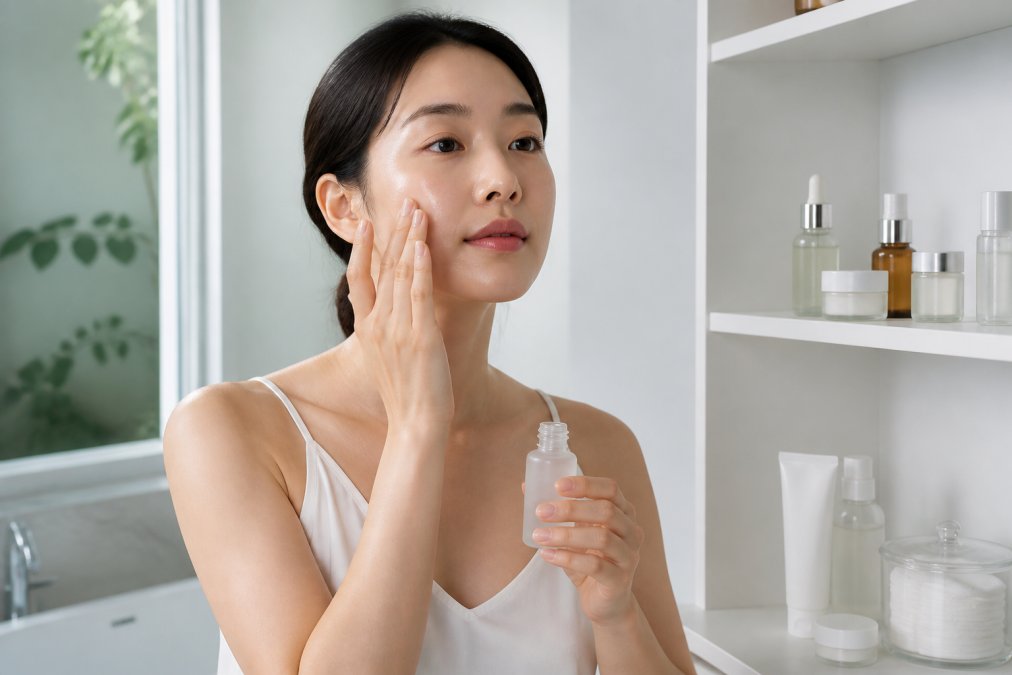
Person applying lightweight Korean serum to face in bright, minimalist bathroom with neatly arranged skincare products on white shelf and soft natural window lighting
A basic routine takes 5-10 minutes. Morning: cleanse, toner, serum, moisturizer, SPF. Evening: cleanse, toner, essence, serum, moisturizer. Once weekly, replace the evening moisturizer step with a sheet mask. This consistency allows your skin barrier to strengthen and sensitivity to diminish over time.
Best Korean Skincare for Redness and Irritation
Redness and irritation require targeted ingredients that calm inflammation without irritating further. The best korean skincare for redness addresses the root cause, barrier damage and inflammation, rather than just masking the symptom.
Centella Asiatica is the gold standard. Products formulated with high concentrations of cica can help reduce redness. The ingredient works by supporting skin repair and reducing inflammatory response. Look for cica listed in the first five ingredients.
Niacinamide reduces redness by supporting barrier function and calming inflammation. It also minimizes pore appearance and regulates sebum, making it beneficial for reactive skin. Korean toners and essences frequently feature niacinamide at concentrations that soothe without irritation.
Panthenol accelerates skin repair and provides immediate soothing. The Beautivana Panthenol + Centella Hydrating Mist combines both ingredients specifically for reactive skin. Use it throughout the day to calm irritation.
Snail Mucin provides deep hydration that supports barrier repair. Dehydrated skin appears redder and more irritated. Snail mucin can help plump skin and reduce the appearance of redness.
Hyaluronic Acid at multiple molecular weights hydrates comprehensively. Dehydration intensifies redness. Korean serums and essences layer different weights to deliver hydration at every skin level.
For persistent redness, focus on barrier repair. The Beautivana Ceramide Skin Barrier Moisturizer provides ceramides, hyaluronic acid, and panthenol, a combination that repairs barrier damage and reduces redness. Use it twice daily for 2-3 weeks and expect visible improvement.
How to Use LED Masks on Sensitive Skin Safely
LED masks deliver light therapy that supports skin health, but sensitive skin requires a modified approach. How to use LED masks on sensitive skin safely means understanding which wavelengths suit your complexion and adjusting duration accordingly.
Red light (630 nm) supports collagen production and reduces inflammation. It's generally considered a safe wavelength for sensitive skin. Start with 10-minute sessions, 3 times weekly. Red light is often well-tolerated by reactive skin.
Blue light (415 nm) addresses bacteria and can help with reactive breakouts. However, blue light is more stimulating than red. If you have sensitive skin, use blue light cautiously, perhaps 5-minute sessions, once weekly. Stop immediately if you experience irritation.
Amber light (590 nm) is generally gentler than red and provides similar anti-inflammatory benefits. It's an excellent option for extremely sensitive skin.
Yellow light (570 nm) supports circulation and lymphatic drainage without irritation. It pairs well with red light for sensitive skin protocols.
Never use LED masks on freshly treated or compromised skin. If you've just had a chemical peel, microneedling, or experienced a flare-up, wait at least one week before using light therapy. Your barrier needs time to recover.
Apply a hydrating serum before your LED mask session. The serum enhances light penetration and provides additional soothing benefits. Follow with your regular moisturizer.
Start conservatively. Many people with sensitive skin jump into 20-30 minute sessions and trigger irritation. Begin with 10 minutes, 2-3 times weekly. After two weeks, increase to 15 minutes if no irritation occurs. Most people with sensitive skin find 15-20 minute sessions optimal.
Watch for signs of overuse: increased redness, burning, or sensitivity. If these occur, reduce frequency or duration. LED therapy should feel soothing, not stimulating.
Ingredients to Avoid When You Have Sensitive Skin
Certain ingredients trigger sensitivity in most people with reactive skin. Knowing what to avoid prevents unnecessary irritation and wasted money on products that won't work for you.
High-concentration actives like vitamin C, retinol, and AHAs cause irritation in sensitive skin. Korean brands formulate these at lower concentrations than Western products, but they still require careful introduction. If you use actives, introduce them slowly and use them no more than 2-3 times weekly.
Fragrance is a common irritant. Many Korean products are fragrance-free or lightly scented with essential oils. Check ingredient lists, if fragrance or parfum appears in the first ten ingredients, it's likely too strong for sensitive skin.
Essential oils can irritate despite their natural origin. Lavender, tea tree, and citrus oils are common irritants. If your skin reacts to products, check for essential oils in the ingredient list.
Alcohol denat (denatured alcohol) is drying and irritating. Some Korean toners contain it, so read labels carefully. Look for products that use glycerin or other humectants instead.
Sulfates strip natural oils and damage the barrier. Most Korean cleansers avoid sulfates, but some budget options include them. Avoid sodium lauryl sulfate and sodium laureth sulfate.
Menthol and camphor create a cooling sensation that feels refreshing but can irritate sensitive skin. These appear in some Korean sheet masks and mists.
Salicylic acid and other BHAs exfoliate by dissolving sebum. They're too strong for most sensitive skin. If you need gentle exfoliation, use a physical exfoliant like a soft konjac sponge instead.
Benzoyl peroxide is drying and irritating. It's not common in Korean skincare, but some acne-focused products include it. Avoid it if you have sensitive skin.
The safest approach: stick to products formulated specifically for sensitive skin. These avoid common irritants and prioritize soothing, hydrating ingredients. The Beautivana Asiatica Daily Skincare Set is formulated without fragrance, essential oils, or irritating actives, ideal for reactive complexions.
Conclusion
Treating sensitive skin with Korean products works because the entire system prioritizes hydration, barrier repair, and gentle ingredients over aggressive treatment. Korean skincare philosophy recognizes that reactive skin needs support, not correction. By understanding key soothing ingredients, patch testing carefully, and building a simple routine, you create conditions for your skin barrier to heal and sensitivity to diminish.
The difference between struggling with sensitivity and achieving calm, comfortable skin often comes down to product selection and consistency. Beautivana's curated collection of spa-inspired Korean skincare brings professional-grade care to your routine with fast U.S. shipping. Shop our best sellers and discover how the right products transform sensitive skin.
Frequently Asked Questions
What are the best Korean skincare ingredients for sensitive skin?
Centella Asiatica (cica), panthenol, hyaluronic acid, niacinamide, and squalane are among the gentlest Korean skincare ingredients for sensitive skin. Centella Asiatica soothes irritation and supports the skin barrier, while panthenol hydrates and calms redness. Hyaluronic acid draws moisture into the skin without irritation, and niacinamide strengthens the barrier. Products like the Beautivana Asiatica Daily Skincare Set feature cica-focused formulas specifically designed for sensitive skin comfort.
How do I know if a Korean skincare product is safe for sensitive skin?
Check the ingredient list for gentle, hydrating components and avoid harsh actives like strong acids or high-concentration retinoids. Look for products labeled as hypoallergenic or formulated for sensitive skin. Always perform a patch test on a small area of skin first, waiting 24-48 hours for any reaction. Start with one new product at a time, spacing introductions by at least one week. Products with simple formulas and few ingredients tend to be safer for reactive skin.
How long does it take to see results with Korean skincare for sensitive skin?
Most people notice initial hydration and calming effects within 1-2 weeks of consistent use. Visible improvements in redness, texture, and barrier strength typically appear after 4-6 weeks of daily application. Some ingredients like niacinamide and centella work gradually to strengthen the skin barrier over time. Consistency matters more than speed, using products daily as directed yields better results than sporadic application. If you haven't seen improvement after 8 weeks, reassess your routine or consult a dermatologist.
Can Korean beauty devices like LED masks be used on sensitive skin?
Yes, LED masks can be used on sensitive skin, but require careful introduction and lower settings. Red light (630-700 nm) is generally the gentlest option for sensitive, inflamed skin, while blue light is better for acne-prone conditions. Start with shorter sessions of 5-10 minutes at the lowest intensity setting, gradually increasing as your skin adapts. Always apply a hydrating mist or serum before use to protect your barrier. If you experience stinging, redness, or irritation during or after use, discontinue and wait several days before trying again at a lower setting.
Sensitive skin doesn't have to limit your skincare options. The right Korean products, formulated with Centella Asiatica, panthenol, ceramides, and hyaluronic acid, provide visible, confidence-boosting results. Explore Beautivana's collection of gentle, effective Korean skincare designed specifically for reactive complexions. Experience the luxury of professional-grade care delivered to your door.