

Last Updated: September 28, 2026
Korean serums are better for one structural reason: they are formulated to repair the skin barrier first, then treat concerns second. That single design decision changes everything downstream, from texture to ingredient ratios to how your skin responds over months rather than days. At Beautivana, we hear the same question from customers: why does a lightweight K-beauty serum often outperform a heavier Western one at twice the price?
The answer isn't magic, and it isn't marketing. It's formulation philosophy, and it shows up in ways you can feel within a week.
Below, we'll break down the texture, the fermentation science, the regulatory backdrop, and the myths that keep people from getting results.
The biggest practical difference is texture. Korean serums typically use water-light bases that absorb in seconds, which means you can layer three or four without your skin feeling coated. Western serums often rely on heavier emollient carriers, so stacking them leads to pilling, congestion, or that tight-but-greasy sensation.
Layering matters because different ingredients need different pH and delivery environments. A hydrating serum goes on damp skin; a treatment serum follows once the first layer has settled. Lightweight formulas make that sequence possible.
A common mistake is treating serums like moisturizer. They aren't. Serums deliver concentrated ingredients; moisturizer seals them in. Skip the seal and you lose much of the benefit.
Fermented ingredients are the second pillar. Fermentation breaks down botanical compounds into smaller molecules. You'll see this in ingredient lists as Saccharomyces ferment filtrate, galactomyces, or fermented rice water.
Barrier-first means the formula leads with ceramides, hyaluronic acid, panthenol, and similar humectants before it adds actives. That order matters. A serum built around barrier support tolerates daily use; one built around a single aggressive active often doesn't.
Beautivana's Milky Ceramide Face Serum follows exactly this pattern, combining ceramides, hyaluronic acid, vitamin E, and a mineral complex in a lightweight milky base. It's a good example of the category: moisture-focused, non-greasy, and designed for morning or evening use.

The best Korean skincare for aging skin prioritizes hydration, barrier repair, and gentle brightening over harsh resurfacing. Mature skin loses moisture faster and recovers more slowly, so the ingredients that help most are the ones that support the skin rather than strip it.
Beautivana Clean Rice Enzyme Powder →
Look for these on the label:
A practical starting point is a routine built around a single barrier serum rather than four treatment serums. The Snail Mucin 92% Moisturizer pairs well as the sealing step, with 92% snail secretion filtrate for a soft, hydrated finish.

Serums sit third in the standard sequence, after cleansing and toning but before moisturizer and sunscreen. That position isn't arbitrary: it's the point where skin is clean, prepped, and most receptive to concentrated ingredients.
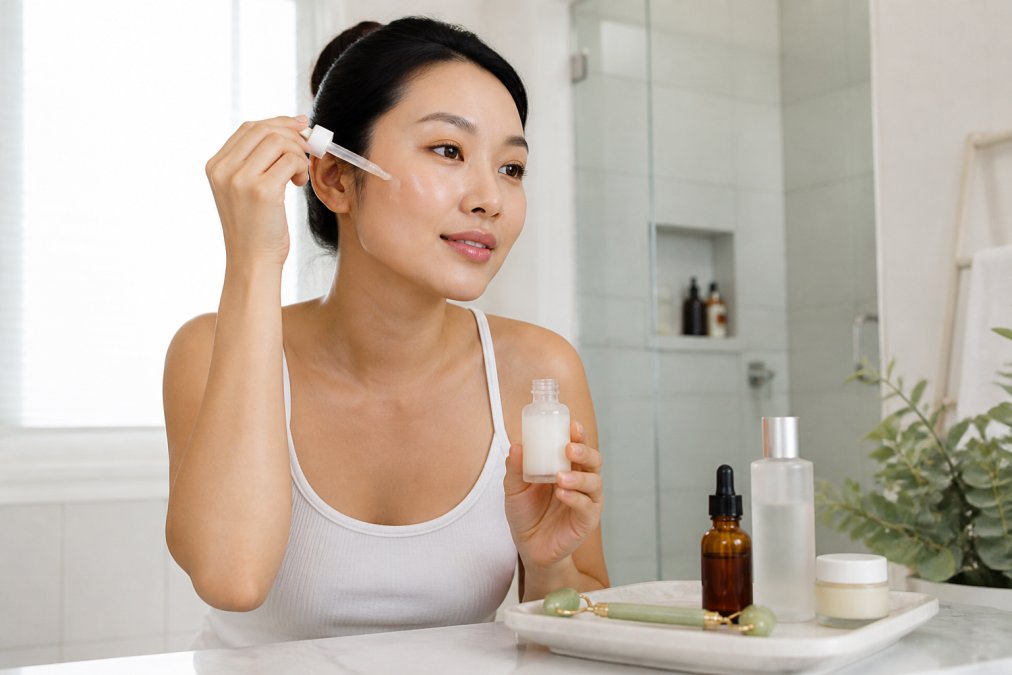
Here's the full sequence and what each step does:
| Step | Product | Purpose | Frequency |
|---|---|---|---|
| 1 | Oil or powder cleanser | Remove makeup and buildup | Daily, AM/PM |
| 2 | Toner mist | Rehydrate and prep | Daily, AM/PM |
| 3 | Serum | Deliver concentrated actives | Daily, AM/PM |
| 4 | Moisturizer | Seal in hydration | Daily, AM/PM |
| 5 | Sunscreen | Protect and prevent | Daily, AM only |
If you're building the routine from scratch, a bundled set removes the guesswork. Beautivana's 4-Step Natural Skincare Set covers cleanser, toner mist, hyaluronic acid serum, and moisturizing cream in one order.

Korean and American skincare products are both regulated as cosmetics, but the approval pathways differ. In the United States, cosmetics are regulated by the FDA's cosmetics guidance and authority, which oversees labeling, safety, and prohibited ingredients but does not pre-approve individual cosmetic products before they reach shelves.
Korean cosmetics are regulated by the Ministry of Food and Drug Safety, which maintains a more prescriptive framework for ingredient review and labeling.
Neither system is inherently "better." What matters for a U.S. buyer is that a product meets FDA labeling requirements and is sold through a legitimate retailer. Counterfeit and gray-market imports are a real problem, and they're the single biggest reason people report disappointing results.
Korean serums and Western serums differ most in concentration philosophy and finish. K-beauty formulas tend to use lower concentrations of multiple actives in a hydrating base; Western formulas often push one hero active at a higher percentage in a richer carrier.
| Factor | Korean Serums | Western Serums |
|---|---|---|
| Texture | Water-light, fast-absorbing | Richer, sometimes occlusive |
| Active strategy | Multiple mild actives | One hero active |
| Layering | Designed to stack | Often used alone |
| Barrier focus | Primary | Secondary |
| Typical finish | Dewy | Matte or satin |
The trade-off is speed versus tolerability. Korean formulas trade a slower start for consistency you can actually maintain.
The most persistent myth is that Korean serums are "weaker" because they use lower active concentrations. That framing misses the point: the goal is cumulative results without compromising the barrier. A serum you can use twice daily for six months outperforms one you quit after two weeks of peeling.
Beautivana Clean Rice Enzyme Powder →
Other myths worth retiring:
What most guides miss is that results depend far more on consistency than on step count. Two well-chosen products used daily beat eight used sporadically.
Authenticity is the variable that decides whether any of this works. Counterfeit serums are common in the resale market, and they often contain fillers, incorrect concentrations, or contaminated ingredients. Buying from a retailer that sources directly and ships domestically is the simplest protection.
If you're searching for authentic Korean serums, prioritize sellers with clear sourcing, fast domestic shipping, and real customer reviews.
Once you have the right product, give it a fair trial. Expect four to six weeks of consistent use before judging results, and photograph your skin in the same lighting weekly to track changes objectively.
Finding a serum that actually fits your skin takes patience, and the market makes it harder by mixing authentic products with convincing counterfeits. Beautivana sources spa-inspired Korean skincare directly and ships fast across the U.S., so you can build a routine around formulas you can trust. Explore our ceramide and snail mucin serums, curated skincare sets, and compatible at-home beauty devices, and give your skin the consistent, barrier-first care it responds to. Get started with Beautivana and build a routine you'll actually keep.
Korean serums often use lighter textures and higher concentrations of hydrating ingredients like ceramides, hyaluronic acid, and fermented extracts. They tend to focus on barrier support and layering, while many American serums target single active ingredients at higher percentages. The result is a gentler feel that works well for daily use and sensitive skin. Brands like Beautivana carry this approach with formulas such as the Milky Ceramide Face Serum, which combines ceramides, hyaluronic acid, and vitamin E in a non-greasy finish.
Korean skincare products sold in the United States fall under FDA oversight as cosmetics. The FDA does not approve cosmetics before they go to market, but it does require that they be safe and properly labeled. In Korea, products are regulated by the Ministry of Food and Drug Safety, which maintains a separate approval process. When you buy from a U.S. retailer, the products must comply with U.S. labeling rules. Beautivana follows these standards for all products shipped within the United States.
Apply your Korean serum after cleansing and toning, but before moisturizer. If you use multiple serums, start with the thinnest consistency and work up to thicker ones. For a simple routine, try the Beautivana 4-Step Natural Skincare Set, which includes a cleanser, toner mist, hyaluronic acid serum, and moisturizing cream. Use the serum in both morning and evening routines, and always follow with sunscreen during the day. Adjust the number of drops based on how your skin feels.
Look for retailers that specialize in Korean beauty and can verify product sourcing. Beautivana ships authentic Korean skincare from its online store to Atlanta and across the U.S., with fast shipping and a curated selection of serums, masks, and devices. You can also check specialty beauty stores in the Atlanta area that carry K-beauty lines. To avoid counterfeits, buy from established sellers, check for proper English labeling, and be cautious of prices that seem unusually low compared to official retail.