

Last Updated: July 11, 2026
The question of whether Korean vs American skincare comparison isn't about one system being objectively superior. Korean skincare emphasizes prevention and hydration through multi-step routines, while American skincare prioritizes active ingredients and clinical efficacy. Neither is universally better, they're different tools solving different problems.
The real opportunity is understanding what each system does best and building a hybrid routine that delivers results. According to dermatology research on skincare efficacy, the most effective routines combine gentle foundational care with targeted active treatments. That's exactly what happens when you blend K-beauty's hydration philosophy with Western skincare's clinical actives.
Korean skincare operates on prevention: stop problems before they start through hydration, barrier repair, and gentle ingredients. American skincare is correction-focused: identify the problem and apply the most potent ingredient that addresses it. Retinol for aging. Salicylic acid for acne. Vitamin C for brightness.
This philosophical difference shows up in product selection. Korean brands formulate with snail mucin, centella asiatica, and niacinamide, ingredients that support skin health over time. American brands emphasize retinol, BHA, AHA, and other actives that create visible change quickly.
Research shows both approaches produce real outcomes. Prevention-focused routines reduce inflammation markers over 12 weeks, while correction-focused routines show faster visible improvements in texture within 4-6 weeks. The trade-off is speed versus sustainability.
Korean skincare favors botanical extracts, fermented ingredients, and hydrating compounds. Snail mucin appears in dozens of Korean products because it contains proteins, hyaluronic acid, and glycoproteins that support skin repair. Centella asiatica (cica) is used because it reduces redness and strengthens the skin barrier.
A typical Korean serum reads like a hydration manifesto: hyaluronic acid (multiple molecular weights), glycerin, niacinamide, and botanical extracts. The goal is to add moisture and support, not force change.
American skincare ingredients are clinical. Retinol increases cell turnover. Salicylic acid dissolves sebum in pores. Vitamin C brightens through oxidation. These are active ingredients designed to create visible results, not to be gentle.
A Korean essence might contain 96% snail mucin, designed to be applied in layers. An American exfoliant contains 2% salicylic acid, the clinical standard for effectiveness. One is about volume and layering; the other is about potency and results.
Korean ingredients support skin health and suit sensitive or compromised skin. American actives are necessary for specific concerns like acne, hyperpigmentation, or significant aging.
The most visible difference is routine structure. Korean skincare is built on layering: multiple lightweight products deliver better results than one heavy product. A typical K-beauty routine includes cleanser, toner, essence, serum, sheet mask, eye cream, and moisturizer. American skincare is simplified: cleanser, active treatment (if needed), moisturizer, sunscreen.
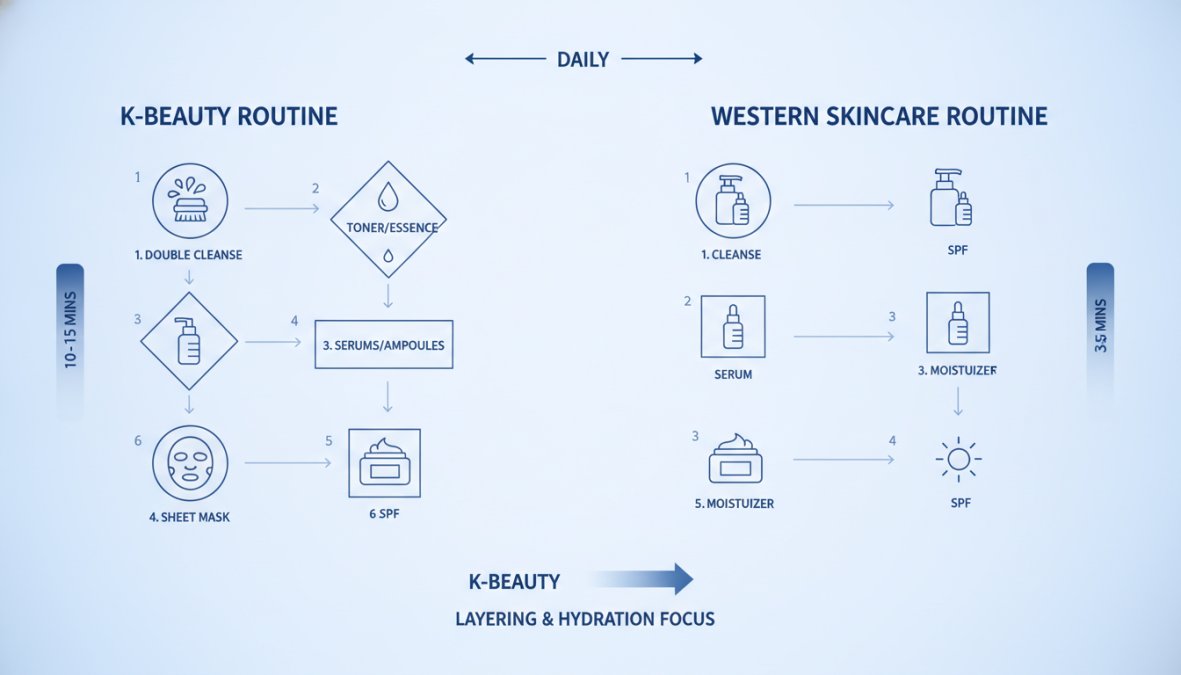
A Korean routine takes 10-15 minutes; an American routine takes 3-5 minutes. This matters psychologically. People who commit to K-beauty are choosing a ritual. People who prefer American skincare are choosing efficiency.
The 10-step Korean skincare routine represents the layering philosophy taken to its logical extreme. Not everyone uses all 10 steps daily.
Step 1-2: Double Cleanse, Oil cleanser removes makeup and sebum; water cleanser removes residue.
Step 3: Exfoliate, Gentle chemical exfoliant (AHA or BHA) removes dead skin cells, 1-3 times weekly.
Step 4: Toner, Hydrates and preps skin to absorb subsequent products.
Step 5: Essence, Lightweight, hydrating liquid applied in layers; distinctly Korean.
Step 6: Serum, Concentrated treatment targeting specific concerns.
Step 7: Sheet Mask, Applied 1-3 times weekly for intensive hydration.
Step 8: Eye Cream, Specialized care for the delicate eye area.
Step 9: Moisturizer, Seals in all previous layers.
Step 10: Sunscreen (AM only), Non-negotiable SPF protection.
The routine isn't done every single day. Sheet masks are weekly; exfoliation is 1-3 times weekly. Daily steps are usually cleanser through moisturizer, 6-7 steps, not 10.
American skincare accomplishes similar goals in 4-5 products: cleanser, exfoliant (if needed), serum or treatment, moisturizer, sunscreen.
American skincare philosophy asks: what's the minimum number of products needed to achieve results? A typical routine is cleanser, active treatment (optional), moisturizer, sunscreen.
The cleanser is usually gentle and non-stripping. CeraVe Hydrating Facial Cleanser removes dirt and makeup while maintaining the skin barrier.
The active treatment is where American skincare gets specific. For acne, use salicylic acid or benzoyl peroxide. For aging, use retinol. For hyperpigmentation, use vitamin C. Paula's Choice Skin Perfecting 2% BHA Liquid Exfoliant is a classic American approach, a single, potent product targeting one specific problem.
This approach works well for people with limited time, simple skin concerns, or skin sensitive to product overload. It also works well for acne-prone skin because fewer products mean fewer potential irritants.
No. A 10-step routine is not necessary for healthy skin. Most dermatologists recommend cleanser, treatment (if needed), moisturizer, and sunscreen, four steps addressing the fundamentals.
The 10-step routine works for people who enjoy skincare as a ritual and have time and budget for it. It's genuinely beneficial for people with compromised, reactive, or aging skin that benefits from intensive hydration. But it's not a prerequisite for good skin.
The real question is: what does your skin actually need? If you have normal, balanced skin and minimal concerns, 4-5 steps is plenty. If you have sensitive or dehydrated skin, adding hydrating layers produces noticeable improvement. If you have specific concerns like acne or hyperpigmentation, you need targeted actives.
Better results come from consistency, appropriate products for your skin type, and patience. A 3-step routine you use every day beats a 10-step routine you abandon.
Snail mucin (snail secretion filtrate) contains compounds that actively support skin repair. It's not just hydrating, it contains glycoproteins that strengthen the skin barrier, hyaluronic acid for moisture retention, and allantoin, which promotes healing. The COSRX Advanced Snail 96 Mucin Power Essence uses 96% snail filtrate.
Centella asiatica (cica) reduces inflammation, supports collagen synthesis, and strengthens the skin barrier. It's particularly valuable for reactive, sensitive, or post-procedure skin.
The hydration focus in Korean skincare supports the skin barrier, the outer layer that protects against environmental damage and water loss. A compromised barrier leads to sensitivity, inflammation, and accelerated aging. Well-hydrated, barrier-healthy skin resists breakouts, shows fewer signs of sensitivity, and appears more radiant.
American skincare ingredients are chosen because they create measurable, visible change. Retinol increases cell turnover, reducing fine lines and hyperpigmentation. Salicylic acid (BHA) penetrates pores and dissolves sebum, treating acne at the source. Vitamin C brightens and supports collagen synthesis.
These ingredients have clinical evidence. Retinol reduces fine lines by 20-30% over 12 weeks. BHA reduces acne lesions by 40-50% in similar timeframes. Paula's Choice Skin Perfecting 2% BHA Liquid Exfoliant uses salicylic acid at the clinically-proven 2% concentration.
The trade-off is irritation potential. Active ingredients work by forcing change, which can cause redness, dryness, or sensitivity during adjustment.
Korean skincare is increasingly available in the U.S., but not always cheaper. A single essence costs $20-30; a sheet mask costs $2-5. A full K-beauty routine reaches $100-150 per month.
American drugstore skincare is extremely affordable. CeraVe Hydrating Facial Cleanser costs around $15.99. Paula's Choice BHA costs about $35. A basic American routine costs $40-60 per month.
Premium American skincare reaches similar price points to Korean skincare. Availability is improving, Sephora, Ulta, and Amazon carry Korean brands, but American drugstore skincare is still more convenient.
Beautivana offers curated Korean skincare like the Beautivana Asiatica Daily Skincare Set ($29.99), which includes centella asiatica cream for hydration and barrier repair, making premium K-beauty accessible.
For sensitive, reactive, or compromised skin: Korean skincare is usually better. The gentle, hydration-focused approach supports barrier health and reduces inflammation.
For acne-prone skin: American skincare is usually more effective. Salicylic acid and benzoyl peroxide address acne at the source.
For aging skin: Both work differently. Korean skincare slows aging through prevention and barrier health. American skincare addresses visible aging through retinol and vitamin C. Combining both produces the best results.
For normal, balanced skin: Either system works. The choice comes down to preference, time commitment, and budget.
For oily skin: American skincare's focus on actives and minimal layering often feels better. However, Korean essences and serums are often lightweight enough for oily skin.
Choose based on what your skin actually responds to, not trend or marketing.
The FDA regulates skincare in the United States. Products making specific claims must have clinical evidence supporting those claims. The KFDA (Korea Food and Drug Administration) regulates skincare in South Korea with similar rigor, though standards differ. Some ingredients approved in Korea are not approved in the U.S., and vice versa.
"Dermatologist-tested" is a marketing claim in both regions. It doesn't mean dermatologists recommend the product, it means a dermatologist tested it for safety. Real clinical evidence is more rigorous: controlled studies with measurable outcomes, published in peer-reviewed journals.
American skincare brands are more likely to publish clinical data because the FDA requires it for certain claims. Korean skincare brands are increasingly doing the same, but it's less common. Both Korean and American skincare products sold in the U.S. must meet FDA safety standards according to FDA guidance on cosmetics regulation.
The real power comes from combining Korean and American skincare philosophies into a hybrid routine that addresses prevention, hydration, and targeted treatment.
Step 1: Foundation (K-Beauty Philosophy) Start with a hydration-focused foundation: cleanser, hydrating toner or essence, and lightweight moisturizer. Use a gentle cleanser like CeraVe Hydrating Facial Cleanser. Add a hydrating essence or toner, where Korean skincare excels. Then moisturize. This foundation takes 5 minutes and addresses the fundamentals.
Step 2: Treatment (American Philosophy) Add targeted actives based on your specific concerns. For acne, add salicylic acid 2-3 times weekly. For aging, add retinol 2-3 times weekly. For hyperpigmentation, add vitamin C daily. This layer is optional if you don't have specific concerns, but it's where visible results happen quickly.
Step 3: Intensive Support (K-Beauty Philosophy) Add hydrating layers on non-active nights. This might be a sheet mask, an additional serum, or an overnight mask. Laneige Water Sleeping Mask EX provides intensive hydration that supports skin recovery after active treatments.
Step 4: Protection (Both Philosophies) Sunscreen every morning, without exception.
A sample hybrid routine:
This approach uses K-beauty's hydration and barrier support as a foundation, layers in American actives for targeted results, and adds intensive support when needed.
Beautivana simplifies hybrid skincare with curated sets designed for this philosophy. The Beautivana Asiatica Daily Skincare Set ($29.99) provides the hydration foundation with centella asiatica cream. The Collagen Jelly Cream Gel Moisturizer ($21.99) adds lightweight hydration that works with actives. The Rice & Black Rice Ampoule Duo ($21.99) provides gentle exfoliation.
These products work as a foundation layer. Layer in your preferred American actives on top, and you have a complete hybrid routine.
The answer to whether Korean vs American skincare comparison is that both systems excel at different things. Korean skincare prevents problems through consistent hydration and barrier support. American skincare solves visible problems through clinical actives. The most effective approach combines both.
Start with a hydration-focused foundation using Korean skincare principles. Add targeted American actives for your specific concerns. Support your skin with intensive hydration on recovery nights. Protect with sunscreen every single day.
Beautivana makes this hybrid approach accessible with curated Korean skincare designed to work as a foundation layer. The best skincare is the one you'll actually use consistently, and a routine that feels sustainable beats a complicated routine you abandon.
Neither is universally better, it depends on your skin. K-beauty emphasizes hydration and skin barrier repair with ingredients like snail mucin and centella asiatica, which suit sensitive or irritated acne-prone skin. American skincare often prioritizes active ingredients like salicylic acid (BHA) and retinol, which directly target breakouts and pores. Many dermatologists recommend starting with gentle hydration (K-beauty approach) and adding targeted actives (American approach) based on tolerance. Combining both philosophies often yields the best results for acne-prone skin.
K-beauty emphasizes prevention, hydration, and skin health through multi-step routines (often 7-10 steps) using gentle, layered products like essences, ampoules, and sheet masks. Western skincare prioritizes efficiency and targeted treatment with fewer, more potent active ingredients like retinol, BHA, and vitamin C. K-beauty focuses on building a strong skin barrier; Western skincare often aims for visible correction of specific concerns. K-beauty products tend to be lighter and more hydrating; American products are typically more concentrated and performance-driven. Both can be effective, the best choice depends on your skin type, concerns, and lifestyle.
No. A 10-step routine is optional and not necessary for most people. Many Korean skincare enthusiasts use 7-10 steps, but you can achieve excellent skin health with 3-5 core steps: cleanser, hydrating toner or essence, moisturizer, SPF, and one targeted treatment (like a serum). The key is consistency and choosing products suited to your skin type. American dermatologists often recommend simpler routines with fewer, clinically-proven actives. Start with basics and add products only if your skin needs them. More steps don't guarantee better results, quality and consistency matter more than quantity.
Korean skincare ingredients like snail mucin, centella asiatica, niacinamide, and rice extract focus on hydration, barrier repair, and skin microbiome balance. These botanical extracts are gentler and work through prevention and nourishment. American skincare emphasizes clinical actives like retinol, salicylic acid (BHA), glycolic acid (AHA), and vitamin C, ingredients with strong clinical trial data for visible correction of wrinkles, acne, and hyperpigmentation. K-beauty ingredients prioritize skin health and glow; American ingredients prioritize measurable results on specific concerns. Both approaches have merit, many skin experts recommend combining gentle K-beauty hydration with targeted American actives for comprehensive care.
This article was written using GrandRanker