

Last Updated: July 5, 2026
Understanding how to layer korean skincare products starts with one fundamental principle: apply products from lightest to heaviest consistency. Lightweight products can't penetrate through heavy ones. If you apply a rich cream before a hydrating essence, that essence sits on top and never reaches your skin, wasting product and benefits.
Viscosity describes how thick or thin a product feels. Water-based toners and essences have low viscosity; serums fall in the middle; creams and oils have high viscosity. Your skin absorbs products based on molecular size and water content. Thinner products have smaller molecules that penetrate deeper, while thicker products create a protective barrier on the surface. A mediocre essence applied correctly will outperform a premium serum applied in the wrong sequence.
Korean skincare emphasizes pH balance because your skin's natural pH is slightly acidic (around 4.5 to 5.5). This acidic environment protects your skin barrier and keeps harmful bacteria at bay. Toners in K-beauty routines restore pH after cleansing, bringing your skin back to its optimal state.
Your skin barrier is a lipid layer that holds moisture in and irritants out. When your pH is off, this barrier weakens, causing increased sensitivity, dryness, and breakouts. According to dermatology research on skin pH and barrier function, maintaining proper pH levels reduces transepidermal water loss by up to 30%, meaning your skin stays hydrated longer and active ingredients penetrate more effectively.
Double cleansing is the non-negotiable first step in any Korean skincare routine. It removes both oil-based and water-based impurities, preparing your skin to receive beneficial products. Oil-based makeup, sunscreen, and sebum don't dissolve in water alone, while water-based dirt and sweat don't dissolve in oil. You need both.
Start with an oil-based cleanser to remove makeup, sunscreen, and sebum. Massage the oil cleanser onto dry skin for 30-60 seconds, then add a small amount of water. The cleanser will turn milky through emulsification, lifting oil-based impurities from your skin. Rinse thoroughly with lukewarm water.
Now use your water-based cleanser to remove any remaining water-soluble impurities and residue from your oil cleanser. Use a gentle formula and massage for 30 seconds, then rinse.
The order of your Korean skincare routine is where theory becomes practice. This is how to layer korean skincare products correctly in both morning and evening sessions.
Your evening routine is where the heavy lifting happens. This is when you apply active ingredients and allow your skin to repair itself overnight.
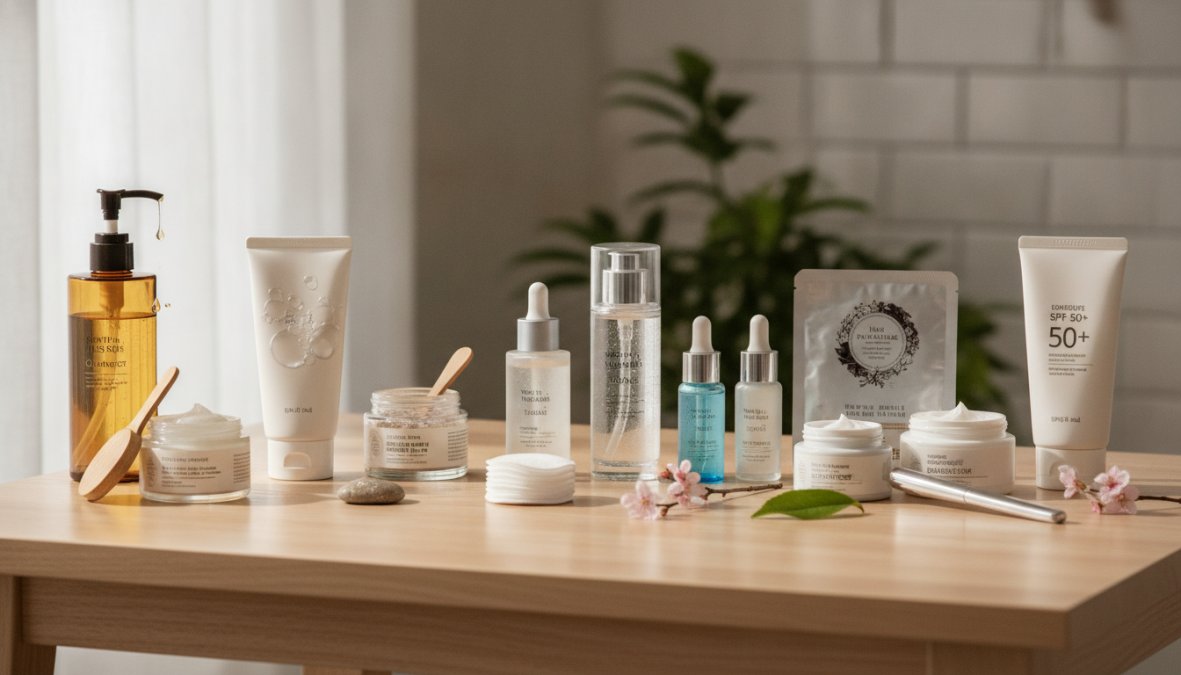
Step 1: Oil-Based Cleanser Apply to dry skin and massage for 30-60 seconds. Add water to emulsify. Rinse thoroughly.
Step 2: Water-Based Cleanser Follow with a gentle water-based cleanser. Massage for 30 seconds and rinse.
Step 3: Toner Apply toner to a cotton pad or directly to damp skin. Pat gently. Toners restore pH balance and prep your skin for the next layers. Wait 1-2 minutes for absorption.
Step 4: Essence Essences are lighter than serums but more concentrated than toners. Pat gently onto damp skin. Wait 1-2 minutes.
Step 5: Serum or Ampoule Apply a pea-sized amount and gently press into skin. If layering multiple serums, apply lightest first. Wait 2-3 minutes between serums.
Step 6: Moisturizer A hydrating moisturizer locks in all the layers beneath it. Use an emulsion for oily skin or a heavier cream for dry skin. Apply with gentle upward strokes.
Step 7: Eye Cream and Lip Balm Use a dedicated eye cream with a gentle tapping motion. Apply lip balm to prevent overnight dryness.
This sequence takes 10-15 minutes total.
Your morning routine is shorter and focuses on hydration and protection rather than active treatment.
Step 1: Water-Based Cleanser Use only your water-based cleanser in the morning. A quick rinse removes any oil buildup from nighttime skin regeneration.
Step 2: Toner Apply toner to restore pH balance after cleansing. Wait 1-2 minutes.
Step 3: Essence (Optional) If your skin is very dry, add an essence. Otherwise, skip this for a faster morning routine.
Step 4: Lightweight Serum Use a hydrating serum rather than an active one. Apply a pea-sized amount and wait 2-3 minutes.
Step 5: Lightweight Moisturizer Use a gel or fluid moisturizer that won't feel heavy under makeup or sunscreen.
Step 6: Sunscreen Apply at least SPF 30, ideally SPF 50. Wait 15 minutes before applying makeup.
Your morning routine takes 5-10 minutes.
| Step | Evening Routine | Morning Routine | Wait Time |
|---|---|---|---|
| 1 | Oil cleanser | Water cleanser | Immediate |
| 2 | Water cleanser | Toner | 1-2 min |
| 3 | Toner | Essence (optional) | 1-2 min |
| 4 | Essence | Lightweight serum | 2-3 min |
| 5 | Serum/Ampoule | Lightweight moisturizer | Immediate |
| 6 | Moisturizer | Sunscreen | 15 min |
| 7 | Eye cream + lip balm |
Timing between layers is crucial. Apply products too quickly, and they don't absorb properly. Wait too long, and your skin dries out between steps.
Toners should absorb within 1-2 minutes. Essences take 1-2 minutes. Serums take 2-3 minutes depending on the formula. Wait until the previous layer feels completely absorbed before applying the next one. Your skin should feel hydrated, not wet or slippery.
Active ingredients like retinol, vitamin C, and exfoliating acids should be applied to completely clean, dry skin. This means waiting 5-10 minutes after cleansing before applying them. Moisture dilutes their potency, reducing effectiveness by 30-50%.
If using multiple actives, apply the strongest one first, then wait 15-20 minutes before applying the next layer. For example, apply vitamin C first, wait 15 minutes, then apply retinol.
These three product categories are the heart of Korean skincare. Understanding the difference between them is essential for proper layering.
Toners restore pH balance and hydrate. They're typically water-based with minimal active ingredients. Essences are richer than toners but lighter than serums, packed with hydrating and nourishing ingredients like niacinamide, peptides, and botanical extracts. According to K-beauty skincare research, toners increase product absorption by up to 40% when used correctly.
Apply toners and essences to damp skin. Pat gently, don't rub or drag, as rubbing can irritate skin and cause pilling.
You can use multiple serums, but you need to understand ingredient compatibility. Serums with different pH levels can interfere with each other. If using a vitamin C serum (acidic) and a niacinamide serum (alkaline), apply vitamin C first. Serums with different molecular weights should be applied from lightest to heaviest.
Some ingredients shouldn't be mixed. Retinol and vitamin C can cause irritation when used together. Apply retinol at night and vitamin C in the morning. Wait 2-3 minutes between serums to prevent pilling and allow each to absorb fully.
Most people make the same mistakes when starting a Korean skincare routine. Knowing what to avoid saves you money, time, and frustration.
Vitamin C and niacinamide together create an unstable compound that can irritate skin. Apply them at different times of day. Retinol and AHAs together increase irritation risk since both increase cell turnover. Use retinol at night and AHAs in the morning, or alternate days.
Benzoyl peroxide and vitamin C together reduce the effectiveness of vitamin C. Sunscreen and certain actives can interfere. Apply vitamin C, wait 15 minutes, then apply sunscreen. Research your specific products before layering them.
Apply a new product to a small, inconspicuous area first, your jawline or behind your ear. Use it for 3-5 days. If no irritation develops, you can apply it to your full face.
Introduce only one new product at a time. Wait 1-2 weeks between introducing new products. Start with low concentrations of actives like retinol (0.25%) twice a week, gradually increasing frequency and strength as your skin adjusts. Research from dermatological patch testing guidelines shows that gradual introduction of actives reduces adverse reactions by 60%.
You don't need expensive products to build an effective Korean skincare routine. Smart choices at every price point deliver results.
Budget routines ($30-50 monthly) focus on essentials: cleanser, toner, essence, moisturizer, and sunscreen. Mid-range routines ($50-150 monthly) add targeted serums like vitamin C or hyaluronic acid. Luxury routines ($150+ monthly) include multiple serums, ampoules, and premium moisturizers designed for specific skin concerns.
The most important principle: a $10 cleanser used correctly outperforms a $100 serum used incorrectly. Master the basics before investing in premium products. Start with budget basics and upgrade strategically as you understand your skin better.
Your skincare routine should change with the seasons and your skin type. In summer, use lighter essences and gel moisturizers. Increase sunscreen application. In winter, switch to heavier moisturizers and richer creams, as your skin loses moisture faster in cold, dry air.
For oily skin, use water-based toners and lightweight serums. For dry skin, use hydrating toners and essences with richer moisturizers. For sensitive skin, simplify your routine with gentle, fragrance-free products and skip active ingredients initially. For combination skin, use different products on different zones, lightweight on your oily T-zone, richer on dry cheeks.
The key is listening to your skin. Adjust seasonally and whenever your skin's needs change.
Building an effective Korean skincare routine requires understanding how to layer korean skincare products correctly. The fundamentals, double cleansing, pH balance, and proper layering order, matter more than expensive products. Start with the basics, master the technique, and gradually add targeted serums and treatments. Beautivana's curated collection of hydrating serums and collagen-rich masks simplifies this process with professional-grade formulations designed for visible results.
The golden rule is thin to thick: start with double cleansing (oil-based, then water-based cleanser), followed by toner, essence, ampoule, serum, emulsion, moisturizer, and sunscreen in the morning. Each lightweight product should be fully absorbed before applying the next heavier layer. This order ensures maximum hydration and nourishment while maintaining your skin barrier.
Wait 30-60 seconds between each layer for lightweight products like toners and essences, allowing them to fully absorb. For heavier serums and ampoules, wait 1-2 minutes. This timing prevents pilling and ensures each active ingredient can penetrate effectively without interference. If you're in a rush, pat products in gently rather than skipping the wait time entirely.
The biggest mistakes include applying products in the wrong order, not waiting between layers, mixing incompatible active ingredients (like vitamin C with niacinamide), and using too many products at once. Avoid layering multiple exfoliating actives or mixing oil and water-based products incorrectly. Always patch test new products for 1-2 weeks before full integration into your routine.
Yes, but with caution. The layering principle remains the same: thin to thick, lightweight to heavyweight. Focus on ingredient compatibility rather than brand origin. Avoid mixing conflicting actives like retinol with vitamin C on the same night. K-beauty products excel at hydration and nourishment, so they layer well with Western serums and moisturizers when applied in the correct viscosity order.
This article was written using GrandRanker