

Last Updated: July 22, 2026
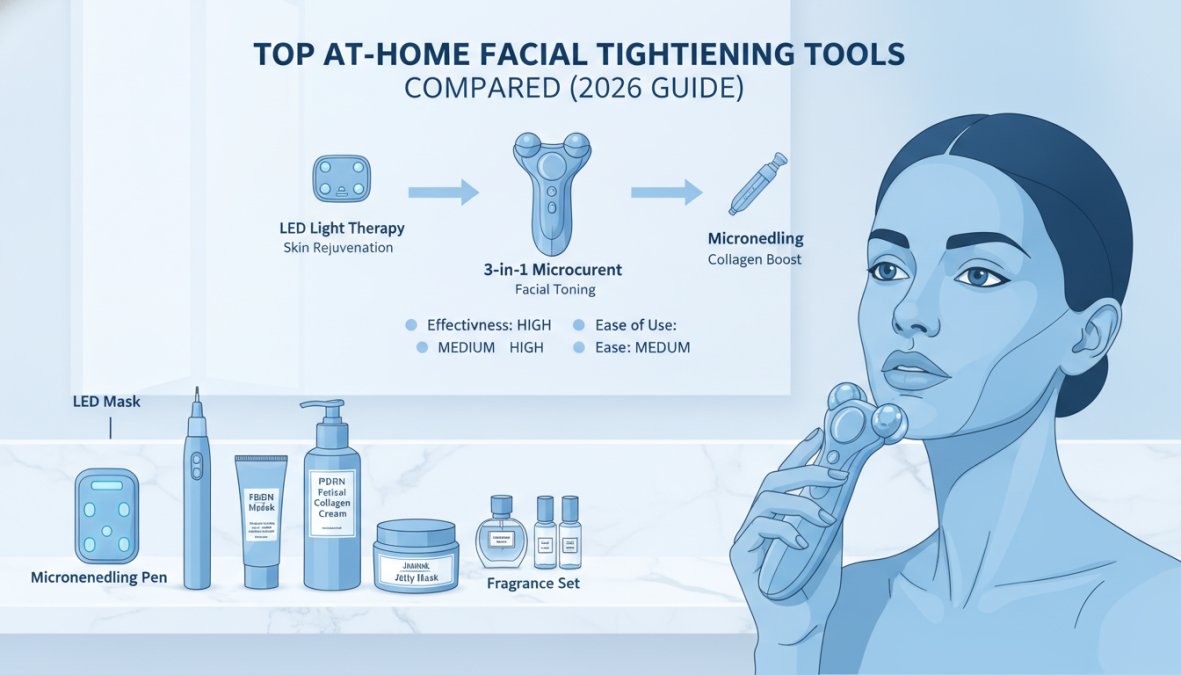
The at-home facial tightening tools 2026 market features devices designed to replicate professional results. Three core technologies dominate: microcurrent, radiofrequency, and LED light therapy. These technologies stimulate collagen production and enhance skin elasticity through various mechanisms. However, the effectiveness of these devices can vary by individual. Non-invasive skin tightening has become mainstream, with dermatologists recommending at-home devices as effective maintenance tools between professional treatments. Users may find that some devices require regular daily use for optimum results, while others provide lasting improvements with less frequent application.
Below, we will discuss how these devices function, the supportive clinical evidence, tools that yield real results, and guidance for safe usage.
Microcurrent technology emulates the body's natural electrical signals to stimulate facial muscles, thus improving tone. By utilizing low-level electrical currents, microcurrent devices induce micro-contractions in the underlying facial muscles, providing a workout for your face. This process triggers the production of ATP (adenosine triphosphate), the energy molecule that fuels muscle activity. Increased ATP leads to heightened muscle tone and responsiveness. Regular use can lead to visible toning and a reduction in sagging, particularly around the jawline and cheeks.
Devices that operate at 600 microamps or higher are most effective. Many users report visible improvements within 4-6 weeks of consistent daily use of 5-10 minutes. However, results may plateau without continued maintenance.
Contrasting with microcurrent devices, radiofrequency (RF) technology focuses on heating deeper layers of the skin to promote collagen remodeling and synthesis. RF targets the dermal layer where collagen and elastin reside. The produced heat initiates the body’s wound-healing response, encouraging fibroblasts to generate fresh collagen and tighten existing fibers. Devices like the Beautivana RF & EMS Facial Beauty Device seamlessly combine microcurrent and RF technology, providing an accessible price point.
These RF devices typically heat skin to about 40-42°C. While RF results tend to emerge gradually over time, users can experience visibly tightened skin within 8-12 weeks of consistent usage. Improvements can last for months, as RF-stimulated collagen remains stable for longer periods than muscle-toned results.
It's vital to remember that RF devices need a conductive gel and should be used with care to prevent burns. Heat must be evenly distributed, and taking your time to apply the device correctly yields better outcomes.
LED light therapy employs different mechanisms compared to microcurrent and RF. Red and near-infrared wavelengths penetrate the skin to stimulate mitochondria, increasing ATP production and collagen synthesis. The 3-in-1 Microcurrent Facial Beauty Device retails at $79.75 and includes LED light therapy, providing a multi-modal approach to skincare.
Red light (630 nanometers) is particularly effective for collagen stimulation and combating aging signs, while near-infrared light (850 nanometers) penetrates deeper layers to enhance skin healing. Combining LED therapy with microcurrent amplifies the overall results; the light energizes cells while the electrical current tones facial muscles. Though LED therapy is generally safe with minimal irritation risks, the results tend to be more subtle compared with RF or microcurrent. Users may observe gradual enhancements in skin texture and tone over the span of 8-12 weeks, but LED therapy alone is not as effective for lifting as RF or microcurrent.
The answer is yes, but with necessary caveats. Clinical research supports that at-home facial tightening devices can achieve measurable improvements in skin elasticity, muscle tone, and collagen density. Studies published in the Journal of Cosmetic Dermatology show that microcurrent devices can lead to a 5-15% increase in skin firmness when used regularly over 12 weeks. Similarly, radiofrequency devices yielded 10-20% enhancement in skin tightness.
At-home devices are more effective for prevention and maintenance rather than correcting prominent sagging. Thus, individuals aged 35-50 with mild to moderate skin laxity will experience noticeable improvements. However, those aged 65 and above with significant jowls will benefit from at-home tools, yet may still require professional treatments for complete resolution.
Legitimate manufacturers provide before-and-after photos depicting real results, albeit under ideal lighting conditions. Genuine improvements manifest as smoother textures, more defined jawlines, reduced puffiness, and better overall skin tone. Notably, many users find friends likely notice changes before they personally do. The improvements are cumulative and gradual, thus harder to detect when you look in the mirror.
Understanding the total cost of ownership extends beyond the initial purchase price of a device like the Beautivana RF & EMS Facial Beauty Device, which retails around $68.00. Most devices require a conductive gel for each application, costing an average of $10-15 monthly with regular use. Therefore, total expenses could reach around $120-180 annually. Replacement parts of high-quality devices can range from $30 to $50, needing occasional substitutes every couple of years. Counting these additives, the cost of ownership might approach $400-500 over five years, which although substantial, is still significantly lower than the price of professional RF sessions ranging from $300-500 each.
The durability of these devices varies by manufacturer and usage. Beautivana models are purported to maintain their performance over 2-3 years even with regular use.
| Device | Starting Price | Technology | Best For | Key Advantage |
|---|---|---|---|---|
| 3-in-1 Microcurrent Facial Beauty Device | $79.75 | Microcurrent + LED + massage | All skin types | Multi-modal approach |
| Beautivana BeautyBiowave RF | $74.00 | Radiofrequency | Collagen stimulation | Affordable RF technology |
| Beautivana RF & EMS Facial Beauty Device | $68.00 | RF + EMS microcurrent | Combination benefits | Best value dual-tech |
| NuFace Trinity+ | $395 | Microcurrent | Professional-grade results | Immediate visible toning |
| FOREO BEAR | $329 | Microcurrent + T-Sonic | Quick treatments | 2-minute sessions |
| Ziip HALO | $399 | Microcurrent + Nanocurrent | Multiple skin concerns | App-guided treatments |
This versatile device combines three complementary technologies, making it ideal for beginners. Microcurrent will deliver immediate muscle toning, while LED therapy supports long-term collagen formation. The massage feature enhances blood circulation and lymphatic drainage, all for $79.75, offering excellent value without compromising on quality.
Users typically observe noticeable improvements in jawline definition and cheek lift within 3-4 weeks of consistent use. Its lightweight ergonomic design facilitates easy 10-15 minute sessions without hand fatigue, with battery life supporting about 20 sessions per charge.
The Beautivana BeautyBiowave RF, priced at $74.00, offers professional-grade RF capabilities. Suitable for those seeking effective skin tightening focusing on collagen rejuvenation, it surpasses microcurrent in terms of deeper effects.
The device efficiently achieves therapeutic temperatures and includes an ergonomic design. Users often experience significant improvements in skin firmness and texture after 8-10 weeks of regular use, requiring 2-3 sessions weekly for best results.
The caveat is RF technology necessitates more precise application; using conductive gel evenly and applying the device slowly is crucial to avoid burns or skin irritation.
At $68.00, this device uniquely combines RF technology with EMS microcurrent to harness dual benefits at an economical price. The synergy between RF and EMS contributes both immediate and longer-lasting improvements to your skin.
Designed with ease of use in mind, it offers simple intensity controls and includes a travel-friendly case. Users can enjoy productive 15-20 minute sessions, with speedy charging capabilities. Notably, while it lacks LED therapy and massage functions, it provides remarkable value considering its blend of essential core technologies.
The NuFace Trinity+, priced at $395, is recognized as a top-tier microcurrent device that showcases results that validate the investment for dedicated users. FDA-cleared, it has three interchangeable attachments along with high-quality conductive gel enabling rapid results.
Major drawbacks are the requirement for near-daily use to maintain results; skipping sessions diminishes benefits quickly. Furthermore, ownership costs increase due to the need for costly replacement gel cartridges.
Technique plays a crucial role in the effectiveness of at-home facial tightening tools 2026. Initiate usage at the lowest intensity setting and gradually increase over a period of 2-3 weeks as your skin adapts. When using microcurrent devices, follow a slow and gentle upward motion, tracing your face’s natural contours. Always progress from the center to the outer edges.
For RF devices, applying the device slowly is even more critical. RF technology works through heat accumulation, which requires adequate time for skin to achieve therapeutic levels. Spending 1-2 minutes on each region using small circular movements is ideal.
Using conductive gel for microcurrent and RF devices is essential. Failure to do so may lead to reduced effectiveness and increased irritation risks. Generically available conductive gels suffice.
Apply a sufficient yet not excessive amount of gel - it should create an even thin layer. To safeguard your skin barrier, limit use of these devices initially to 4-5 times weekly, reducing afterwards to 2-3 times weekly as your skin accommodates. Post-treatment, rinse the gel off with lukewarm water and apply a hydrating moisturizer. The device temporarily opens pores, enhancing absorption of hydrating products.
Individuals with pacemakers or electronic medical implants should sidestep microcurrent and RF devices, as electrical currents can interfere with these devices' functions. Pregnant women are also advised to avoid these devices due to uncertainty regarding safety.
Infections, severe acne, or recent facial peels require a waiting period of 2-3 weeks before usage. Medications that heighten photosensitivity (certain antibiotics, retinoids, or NSAIDs) may amplify sensitivity to LED therapy. Grant caution to those with highly sensitive skin, starting with LED-only therapy before introducing microcurrent or RF applications.
Ensure that you confirm the device is designed for at-home applications and clearly specifies power output (microamps for microcurrent and watts for RF), rather than using vague language. Additionally, ergonomic design is essential; since frequency of use will be high, consider the weight, grip comfort, and configuration of buttons.
Check what accessories are included with purchase, such as gel, replacement components, and travel cases. Devices that include these are typically a better value. Investigate warranty and customer service policies; getting proper support is critical. Moreover, look for adjustable intensity levels, allowing for gradual policy adaptation. Lastly, factor in maintenance requirements, as devices requiring specialized conductive gel or frequent component replacement can become costly over time.
At-home facial tightening tools represent a genuine alternative between skincare methods and professional treatments. While they require regular use and a mindset of realistic expectations, Beautivana’s lineup of RF and microcurrent devices delivers professional-grade technology at accessible pricing with efficient U.S. shipping and support. If you wish to embrace consistent at-home skin tightening solutions, these devices can yield visible, long-lasting outcomes without the need for extensive time or financial commitment involved with professional treatments.
Yes, at-home facial tightening devices can deliver measurable results when used consistently. Microcurrent and radiofrequency technologies stimulate collagen production and improve skin elasticity, with many users reporting visible lifting and improved facial contour within 4-8 weeks of regular use. However, results are typically more subtle than professional treatments and require ongoing commitment, stopping use often leads to gradual regression.
Microcurrent devices deliver low-level electrical currents that mimic the body's natural bioelectric signals, toning facial muscles and improving skin texture. Radiofrequency (RF) devices use heat energy to stimulate deeper collagen regeneration and skin tightening. RF typically produces more dramatic results for sagging skin, while microcurrent excels at facial sculpting and puffiness reduction. Many professional-grade devices combine both technologies for enhanced results.
Most devices recommend 3-5 times per week for optimal results, with sessions lasting 5-15 minutes depending on the tool. Daily use is generally not necessary and may irritate sensitive skin. Consistency matters more than frequency, regular weekly use produces better long-term results than sporadic intensive sessions. Always follow the manufacturer's guidelines and allow rest days to prevent skin fatigue.
Yes. Avoid these devices if you have a pacemaker, are pregnant, have active skin infections, or use certain medications like Accutane. Those with sensitive skin should start with lower intensity settings. Always use conductive gel to protect your skin barrier and ensure proper current distribution. Consult a dermatologist before use if you have metal implants, recent facial surgery, or underlying medical conditions.
Initial device costs range from $68-$399, with Beautivana's options at $68-$79.75 for quality RF and microcurrent devices. Ongoing costs include conductive gel (typically $15-$30 per tube, lasting 2-3 months) and occasional replacement parts. Over 3 years, total investment averages $150-$600, significantly cheaper than monthly professional facials ($100-$300 each). Device lifespan typically ranges from 3-5 years with proper care.
This article was written using GrandRanker