

Last Updated: July 14, 2026
When shopping for anti-aging skincare, LED facial masks have become one of the most accessible clinical-grade treatments available for home use. These devices use specific wavelengths of light to stimulate cellular repair and collagen production. Research shows that red light therapy at 630 nanometers and near-infrared light at 830 nanometers effectively trigger photobiomodulation, the process by which cells repair themselves and produce more collagen.
Light-emitting diode therapy delivers specific wavelengths directly to skin cells, triggering biochemical reactions that boost collagen production. The most effective wavelengths for anti-aging are red light (typically 630 nanometers) and near-infrared light (typically 830 nanometers), which penetrate the epidermis and reach the dermis where collagen and elastin fibers live.
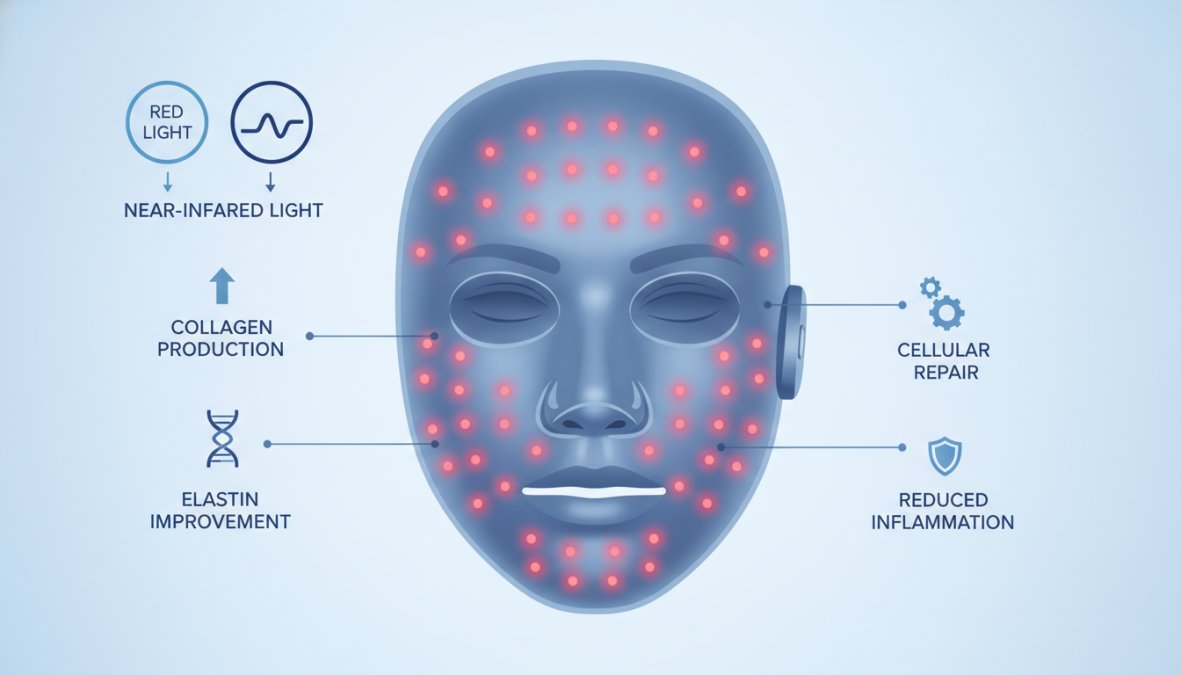
Red light operates at visible wavelengths between 600-700 nanometers, appearing as a warm glow on your skin. Near-infrared light exists just beyond the visible spectrum at 700-1100 nanometers, invisible but powerfully effective. Red light primarily affects surface-level concerns like fine lines and texture, while near-infrared penetrates deeper to stimulate collagen production in the dermis.
According to Stanford Medicine research on light therapy, near-infrared wavelengths trigger the most significant collagen synthesis response. The best LED masks combine both red and near-infrared in a single device for both surface improvement and deep structural repair.
Photobiomodulation is how light energy stimulates cells to produce energy and repair themselves. When red and near-infrared light hits your skin, it energizes mitochondria, the powerhouses of your cells. This energy boost triggers fibroblasts (cells that produce collagen and elastin) to work harder and faster.
When light penetrates the skin, chromophores transfer energy to mitochondria, increasing ATP production (cellular energy). This energy boost activates fibroblasts to synthesize new collagen and elastin fibers. Clinical studies show that consistent red light therapy increases skin elasticity and reduces fine lines within 8-12 weeks of regular use.
(https://cbu13r-hj.myshopify.com/products/7-color-silicone-led-light-therapy-facial-mask) Works for Anti-Aging]The LED facial mask market offers options ranging from budget-friendly to premium clinical-grade systems. A proper review requires evaluating wavelength accuracy, light distribution, comfort, durability, and real-world results.
Beautivana 3D Wireless LED Facial Mask ($155.00) balances professional-grade technology with accessible pricing. This device uses dual-wavelength technology combining red (633nm) and near-infrared (830nm) light across flexible silicone construction. The wireless design eliminates cord tangling, and most users report visible improvements in fine lines and skin texture within 3-4 weeks of consistent use (3-4 times per week).

Omnilux Contour Face ($395.00) is the clinical gold standard for red light therapy. This flexible silicone mask uses clinically proven wavelengths (633nm red and 830nm near-infrared) tested in peer-reviewed studies showing measurable improvements in fine lines and skin elasticity. The 10-minute treatment protocol is shorter than most competitors.
Dr. Dennis Gross DRx SpectraLite FaceWare Pro ($455.00) combines red and blue light in a hard-shell design with 162 individual LED lights. The blue light wavelength (465nm) targets acne-causing bacteria, making this device useful for treating both aging signs and active breakouts. The 3-minute treatment time is the fastest on the market.
CurrentBody Skin LED Light Therapy Mask Series 2 ($469.99) offers enhanced power output for deeper light penetration. The flexible silicone construction suits all face shapes, and users report noticeable firmness improvements within 6-8 weeks.
Qure Q-Rejuvalight Pro ($399.00) stands out for app-controlled customization, offering five different light wavelengths to target specific facial areas. The drawback is setup complexity requiring app pairing via Bluetooth.
HigherDOSE Red Light Face Mask ($349.00) prioritizes portability and simplicity. This lightweight silicone mask combines red and near-infrared light in a wireless, battery-powered design that fits easily into a travel bag.
Skin Gym LED Pro Light Therapy Mask ($299.99) delivers multi-wavelength capability at an accessible price, including red (630nm), blue (465nm), and near-infrared (830nm) light. The 10-minute treatment sessions fit easily into a daily routine.
Project E Beauty Lumamask Pro ($169.00) is the most affordable option delivering credible red, infrared, and blue light wavelengths. For someone testing whether LED therapy works before investing significantly, this entry point makes sense.
| Device | Price | Best For | Key Wavelengths |
|---|---|---|---|
| Beautivana 3D Wireless | $155 | Balanced results at mid-range price | 633nm + 830nm |
| Omnilux Contour | $395 | Clinical validation and research backing | 633nm + 830nm |
| Dr. Dennis Gross DRx | $455 | Acne + anti-aging combination | Red + Blue |
| CurrentBody Series 2 | $470 | Long-term investment with high power | 633nm + 830nm |
| Qure Q-Rejuvalight | $399 | Customized, targeted treatments | 5 wavelengths |
| HigherDOSE | $349 | Portable, simplicity-focused | 630nm + 830nm |
| Skin Gym LED Pro | $300 | Budget-conscious multi-wavelength | 630nm + 465nm + 830nm |
| Project E Beauty | $169 | First-time users testing LED therapy | Red + Blue + IR |
LED facial masks deliver measurable, visible improvements that develop over weeks and months of consistent use, addressing multiple skin concerns simultaneously.
Red light therapy's primary anti-aging benefit is reducing fine lines and wrinkles through increased collagen production. When fibroblasts receive the energy boost from light therapy, they synthesize new collagen fibers that gradually fill in creases and improve skin thickness. Most users notice softening of fine lines around the eyes and mouth within 4-6 weeks of consistent use (3-4 times weekly).
Skin elasticity improvements follow a similar timeline as new collagen fibers form and cross-link, making skin firmer and more resilient.
LED therapy improves overall skin texture and radiance within 2-3 weeks. Increased collagen production creates a more uniform skin surface that reflects light more evenly. Improved circulation from the photobiomodulation process delivers more oxygen and nutrients to skin cells, enhancing natural skin tone.
Proper use determines whether you see results. LED therapy requires consistency, correct positioning, and awareness of safety considerations.
Start with clean, dry skin. Wash your face with your regular cleanser and pat completely dry; water can interfere with light penetration. Skip serums and moisturizers immediately before LED therapy; apply them afterward instead.
The ideal routine: cleanse → LED mask treatment → wait 10 minutes → apply serums and moisturizer. Use your LED mask at the same time each day if possible. Start slowly if new to LED therapy, using 2-3 times per week for the first 2 weeks, then increase to 4-5 times weekly if your skin tolerates it well.
Always wear the protective eyewear included with your device, or keep your eyes closed during treatment. Some users experience mild redness or warmth during the first few sessions; this is normal and typically subsides within 1-2 weeks.
Avoid LED therapy if you're taking photosensitizing medications (certain antibiotics, retinoids, or NSAIDs). Check with your doctor or pharmacist if unsure about your current medications.
Device manufacturers recommend specific treatment times based on light intensity. Most masks require 10-20 minute sessions, though some high-powered devices deliver results in as little as 3-5 minutes.
For most LED masks, 3-4 sessions per week is optimal for anti-aging. This frequency allows your skin to recover between sessions while maintaining consistent light stimulation. Treatment duration depends on your device's light intensity. Low-power masks require 20-minute sessions, mid-range devices work effectively in 10-15 minutes, and high-powered clinical devices deliver results in 3-10 minutes.
Most users notice subtle improvements in skin radiance and smoothness within 2-3 weeks of consistent use. Fine lines and wrinkles begin softening noticeably around week 4-6. More dramatic improvements in skin firmness and elasticity typically emerge at the 8-12 week mark. Long-term users (6+ months) report continued improvements as new collagen production balances natural breakdown.
LED therapy is generally safe, but specific populations should avoid it or use it cautiously.
Pregnant women should consult their obstetrician before using LED masks. People with a history of melanoma or suspicious skin lesions should get dermatologist clearance. Thyroid conditions require caution, avoid directing light at your neck area where your thyroid sits.
Photosensitivity disorders (such as porphyria or polymorphous light eruption) are absolute contraindications. Recent facial procedures (chemical peels, laser treatments, microneedling) require a 2-3 week waiting period before LED therapy.
LED masks are durable when properly maintained. The light-emitting diodes gradually dim over thousands of hours of use. A typical mask used 4 times weekly for 15 minutes per session will operate effectively for 3-5 years before noticeable light output reduction.
Extend device life by keeping the light-emitting surface clean with a soft, dry cloth after each use. Avoid moisture inside the device and store in a cool, dry place away from direct sunlight. For battery-powered devices, charge when the battery drops to 20-30% rather than draining completely.
Red light (600-700 nanometers) excels at anti-aging by penetrating moderately deep into the dermis, stimulating collagen production and improving skin elasticity. It also has anti-inflammatory properties, making it suitable for sensitive skin.
Blue light (400-500 nanometers) targets acne-causing bacteria and doesn't penetrate as deeply as red light but effectively kills bacteria on the skin's surface. Blue light also has sebum-regulating properties, reducing oil production that feeds acne.
For pure anti-aging without active acne, red and near-infrared light alone is sufficient. If treating both aging and breakouts, a device offering red and blue light addresses both concerns simultaneously. Near-infrared light (700-1100 nanometers) penetrates deepest and triggers the strongest collagen response.
Evaluating masks requires understanding what actually matters versus marketing hype.
FDA clearance means the device has been tested for safety and efficacy. Look for devices explicitly labeled "FDA-cleared" on the packaging or website. Clinical evidence matters more than brand prestige. A lesser-known device using proven 630nm and 830nm wavelengths will outperform an expensive brand using unproven wavelengths.
According to FDA guidance on light-based devices, manufacturers must demonstrate safety and efficacy through controlled studies.
Flexible silicone masks conform to different face shapes, providing even light distribution and comfortable fit. Silicone degrades over time with repeated stretching; a quality silicone mask lasts 3-5 years with proper care.
Hard-shell devices are more durable and don't degrade like silicone. However, they feel less comfortable during extended sessions, and poor fit on non-standard face shapes creates light gaps. For most users, silicone offers the better experience.
| Design Type | Comfort | Durability | Light Distribution | Best For |
|---|---|---|---|---|
| Silicone | Excellent | 3-5 years | Even (conforms to face) | Daily users prioritizing comfort |
| Hard-Shell | Good | 7+ years | Consistent (fixed shape) | Users wanting maximum durability |
Treatment intensity also matters. Higher-wattage devices deliver results faster but require shorter sessions and cost more. For someone committing to long-term use, investing in a higher-quality mid-range device often justifies the price difference over budget options you'll replace within 2 years.
LED facial masks represent a legitimate, accessible approach to anti-aging that delivers measurable results when used consistently. Choose a device with proven wavelengths, comfortable design, and durability to support your long-term skincare goals. Beautivana's 3D Wireless LED Facial Mask combines clinical-grade red and near-infrared wavelengths with wireless convenience and silicone construction, delivering professional results at a fraction of premium brand prices. Start with 3-4 sessions weekly, maintain consistent use for at least 8 weeks, and you'll see noticeable improvements in fine lines, skin elasticity, and overall radiance.
LED facial masks use red and near-infrared light wavelengths to stimulate collagen production and cellular repair, which can reduce fine lines and wrinkles over time. Clinical trials on devices like the Omnilux Contour Face and CurrentBody Series 2 show measurable improvements in skin elasticity and texture. Results typically appear after 4-12 weeks of consistent use, depending on your skin condition and device quality. Red light (630-633nm) and near-infrared (830nm) wavelengths are most effective for anti-aging benefits.
Most FDA-cleared LED facial masks recommend 10-20 minute treatment sessions, with some premium devices like the Dr. Dennis Gross DRx requiring only 3 minutes due to higher light intensity. Daily or 5-7 times per week usage is standard for anti-aging results. Consistency matters more than duration, regular short sessions outperform occasional longer treatments. Always follow your specific device's protocol, as exceeding recommended treatment time won't accelerate results and may cause skin irritation.
LED facial masks are generally safe for most skin types when used correctly, but certain conditions require caution. Avoid use if you take photosensitizing medications, have active skin infections, or are pregnant without consulting a dermatologist. Common side effects are minimal and include temporary redness or mild irritation. Always wear eye protection or keep eyes closed during treatment. People with specific skin conditions like severe rosacea or eczema should consult a dermatologist before starting LED therapy to avoid triggering flare-ups.
Red light (630-633nm) and near-infrared (830nm) wavelengths penetrate deeper to boost collagen production and reduce fine lines, ideal for anti-aging. Blue light (465nm) targets surface bacteria and is better for acne-prone skin. Many advanced masks combine both, like the Dr. Dennis Gross DRx and Project E Beauty Lumamask Pro, allowing you to address multiple concerns. For pure anti-aging, red and near-infrared are most effective. Choose blue light modes only if acne is also a priority.
This article was written using GrandRanker
Explore Beautivana LED face masks and complementary at-home facial devices. FREE U.S. SHIPPING — NO MINIMUM