

Last Updated: September 12, 2026
Skin elasticity over 40 is the skin's ability to stretch and snap back into shape, and it depends on two structural proteins: collagen, which provides firmness, and elastin, which provides recoil. After 40, both decline, and the visible result is sagging along the jawline, cheeks, and neck. This guide from Beautivana walks through seven steps that address that decline, from skincare ingredients to at-home devices. Below, we'll show you exactly what changes, what speeds it up, and how to build a routine that produces visible results.
Dermatologists generally describe the shift as a slow, cumulative process rather than a sudden event. Collagen production begins falling earlier than most people realize, and the drop becomes visible in the forties as volume loss and looser skin (the American Academy of Dermatology). The American Academy of Dermatology's guidance on aging skin outlines how sun exposure, smoking, and repeated facial movement all contribute over decades.
Collagen and elastin are the two proteins that keep skin firm and springy, and both thin out with age. Collagen gives skin its structure; elastin lets it bounce back after stretching. When either declines, skin loses support and starts to sag.
Two things happen at once. Existing fibers become fragmented and less organized, and new fiber production slows. Hormonal shifts around menopause accelerate the process for many women. A common mistake is treating sagging as purely a surface problem when it reflects changes in the deeper dermis.
The biggest accelerators of elasticity loss are largely preventable. UV exposure is the most damaging, because it breaks down collagen and elastin directly. Smoking, chronic dehydration, crash dieting, and poor sleep all add to the load.
What most guides miss is how much daily sun exposure matters compared with occasional sunbathing. Ten minutes of unprotected exposure on a commute adds up over years. Broad-spectrum SPF every morning is the single most effective anti-aging step, and it costs less than any serum.
A collagen-supporting routine is a daily regimen built around ingredients that protect existing collagen and support new production. The core is consistent, not complicated.
Start with these essentials:
The FDA's consumer information on sunscreen explains why broad-spectrum protection matters for preventing premature aging, not just sunburn. Order matters less than consistency.
Retinoids, vitamin C, peptides, and niacinamide have the strongest support for firmness. Retinoids stimulate collagen production over time. Vitamin C supports collagen synthesis and defends against oxidative stress. Peptides signal the skin to rebuild, and niacinamide improves barrier function and tone.
What most guides miss is that these ingredients take months, not weeks. A retinoid used twice a week for three months will do more than a strong one used nightly for a week and then abandoned.
The best collagen-boosting skincare for over 40 pairs a retinoid at night with antioxidant protection in the morning. Everything else supports those two anchors.
For a simple, effective pairing, try the Beautivana Retinol Collagen Gua Sha Cream, which combines retinol, collagen, and peptides in a rich face and neck moisturizer. The built-in gua sha-style applicator lets you massage as you moisturize, which many people find makes the nightly step easier to keep up.

To use microneedling devices at home safely, start with the shortest needle length available, cleanse thoroughly, and never share the device. At-home rollers and stamps are designed for superficial use only.
Follow this sequence:
At-home beauty tech uses microcurrent, LED light, or electrical muscle stimulation to temporarily firm and lift the appearance of skin. Results are cumulative and build with regular use.
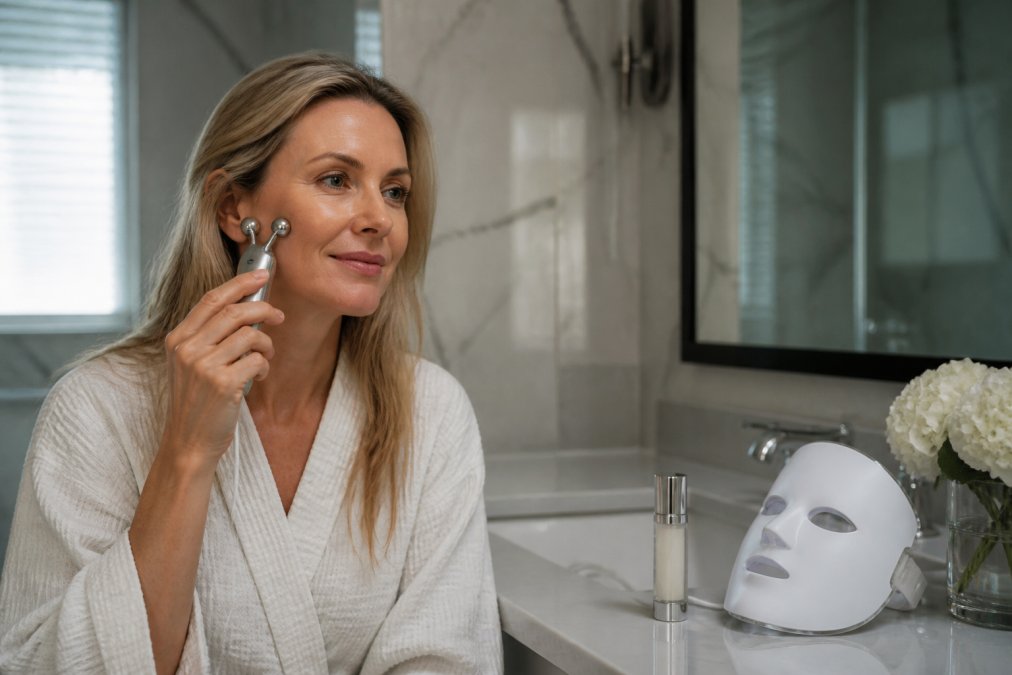
A practical starting point is the Beautivana 3-in-1 Microcurrent Facial Device with LED & Vibration, which combines microcurrent, LED light, and vibration modes in one compact handheld tool. For a fuller routine, the Beautivana 24K Gold, PDRN & EMS Facial Kit bundles a hydrating mask, PDRN serum, an EMS tool, and a headband into one at-home facial set.

Each technology targets a different layer of the problem. Knowing which does what prevents wasted effort.
| Technology | What It Does | Best For | Typical Session |
|---|---|---|---|
| Microcurrent | Low-level current that stimulates facial muscles | Subtle lifting along jaw and cheeks | 5-10 minutes |
| LED light | Light wavelengths that support skin renewal | Tone, redness, overall radiance | 10-20 minutes |
| EMS | Electrical pulses that contract muscles | Firming and definition | 5-10 minutes |
| Ultrasonic | High-frequency vibration to loosen buildup | Deep cleansing before treatments | 3-5 minutes |
For cleansing before any of these, the Beautivana 4-in-1 Ultrasonic Ion Skin Scrubber with EMS Facial Care combines ultrasonic cleansing with Ion+ and Ion− modes plus EMS, so one portable tool covers prep and firming.

Daily habits protect skin elasticity over 40 more than any single product. Sun protection, sleep, hydration, and nutrition all influence how well skin maintains its structure.
Prioritize these:
Many people find that sleep and sun protection produce the most noticeable change within a few months, well before any serum does.
Most people see early changes from skin tightening routines in four to eight weeks, with fuller results at three to six months. Timing depends on the method: hydration and tone improve fastest, while firmness and fine lines take longer.
Set expectations by method:
Consistency matters more than intensity. A routine used five nights a week for six months will outperform an aggressive routine abandoned after three weeks. If you've spent hundreds before and seen nothing, the usual cause is stopping before the timeline was reached.
Professional treatments in Atlanta make sense when at-home care has plateaued or when sagging is significant. In-office options include lasers, radiofrequency, ultrasound-based tightening, and injectables, all performed under medical supervision.
A reasonable approach is to give a home routine three to six months first. If results stall, consult a board-certified dermatologist or licensed provider. Atlanta's humid summers and strong UV index make daily sun protection especially important year-round, and providers here commonly emphasize it alongside any in-office treatment.
Sagging skin after 40 is a structural change, and it responds to a routine built around protection, stimulation, and patience. Beautivana helps you put that routine together with spa-inspired Korean skincare and advanced at-home beauty devices, including collagen-rich masks, hydrating serums, and tools like LED facial masks and microneedling devices. If you're in Atlanta or anywhere in the U.S., the collection ships fast and is designed to make professional-grade care part of your daily ritual. Get started with Beautivana and build a routine that firms, smooths, and restores your skin's natural radiance.
Collagen production drops roughly 1% per year starting in your mid-20s, and the decline accelerates through perimenopause as estrogen falls. Elastin fibers also fragment and lose their ability to snap back. Sun exposure, smoking, poor sleep, and crash dieting speed up the process. That combination is why skin that looked firm at 35 starts to sag and crease more visibly by 45.
You can improve it, but not fully reverse it. Topical retinoids, peptides, and collagen-boosting skincare for over 40 support new collagen formation over weeks to months. At-home devices like microcurrent and LED add temporary firming and longer-term stimulation. Professional procedures such as radiofrequency or microneedling with PRP produce the strongest results. Consistency matters more than any single product.
Microcurrent gives a temporary lift you can see immediately, lasting a day or two. LED and topical collagen-boosting skincare typically show firmer texture in 8 to 12 weeks with daily use. Microneedling at home needs 4 to 6 weeks between sessions and 3 to 4 sessions before collagen remodeling becomes visible. Photograph your skin monthly in the same lighting to track real change.
Yes, within limits. Microcurrent devices produce measurable short-term lifting by stimulating facial muscles. LED masks support collagen production with red and near-infrared light over 8 to 12 weeks. EMS tools tone underlying muscle. None of them match in-office radiofrequency or ultrasound, but used three to five times a week they deliver visible firming that compounds over time.