

Last Updated: July 23, 2026
When choosing between microneedling vs LED therapy for aging skin, the answer isn't about choosing one option over the other. Both treatments utilize different mechanisms to enhance skin quality, working effectively based on your skin type and specific aging concerns. Research indicates that nearly 60% of individuals over the age of 40 look for professional or home treatments to combat fine lines and improve skin elasticity.
| Treatment | How It Works | Best For | Recovery Time | Cost Range |
|---|---|---|---|---|
| Microneedling | Controlled micro-injuries stimulate collagen production through wound healing response | Deep wrinkles, scars, texture | 3-7 days downtime | $150-$300+ per session |
| LED Light Therapy | Photobiomodulation stimulates cellular energy (ATP) and fibroblast activity | Fine lines, inflammation, sensitive skin | Minimal to none | $85-$250+ for device |
| Combination | Both mechanisms work synergistically for enhanced collagen induction and cellular repair | Comprehensive anti-aging | 3-5 days | Device-dependent |
Microneedling creates controlled micro-injuries using tiny needles, triggering your body's natural wound healing response. This process punctures the epidermis and dermis at precise depths, signaling your skin to produce new collagen and elastin fibers.
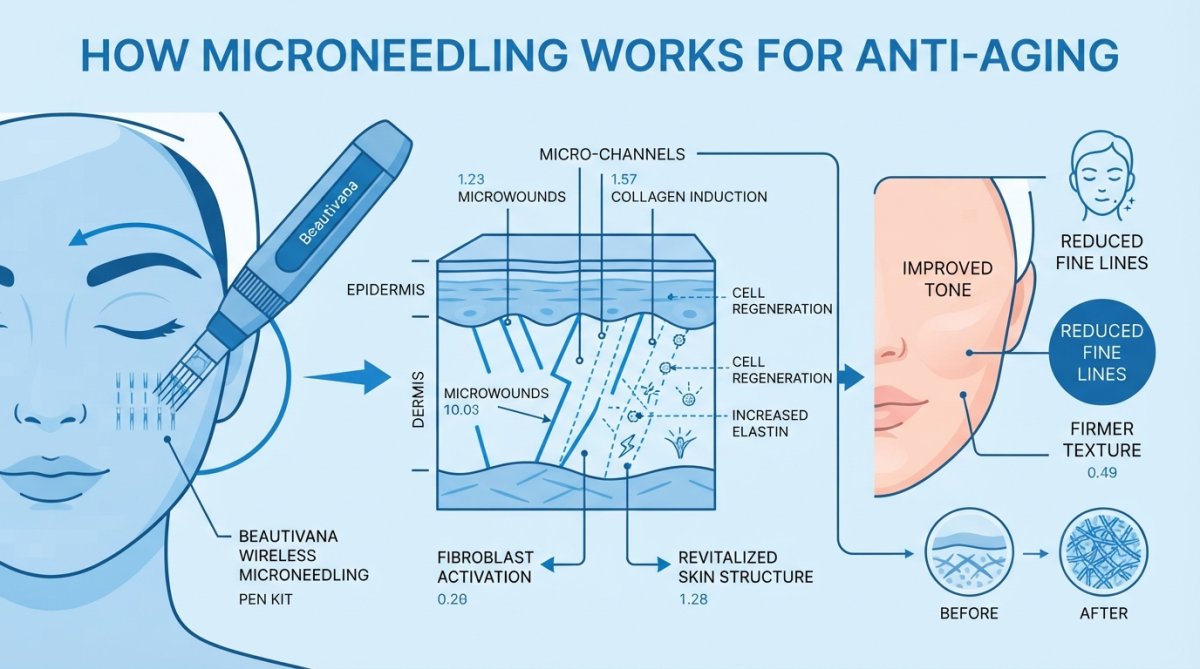
Needle depth determines the skin concerns addressed. Shallow treatments (0.25-0.5mm) improve product absorption and fine surface texture. Medium depth (0.5-1.5mm) targets fine lines and mild scarring. Deeper treatments (1.5-2.5mm) address severe wrinkles, deep acne scars, and skin laxity. Professional microneedling typically utilizes 1.5-2.5mm depths, while at-home devices max out around 0.5-1.2mm.
Microneedling directly stimulates fibroblasts, the cells responsible for producing collagen and elastin. When needles create micro-injuries, your body perceives this as trauma requiring repair. Fibroblasts respond by ramping up collagen synthesis, which continues for weeks and months after treatment. Visible improvements typically emerge over 4-12 weeks as new collagen fibers mature.
The collagen generated is your own, which means results integrate naturally with your skin's structure.
Your skin's wound healing response is a multi-phase process. The inflammatory phase (days 1-3) brings increased blood flow and immune activity. The proliferative phase (days 3-21) is where fibroblasts produce new collagen. The remodeling phase (weeks 3-12) involves maturation of that collagen into functional tissue that firms and smooths the skin.
Multiple treatments spaced 4-6 weeks apart generate compounding collagen production. Dermatologists typically recommend 3-6 sessions for optimal results.
LED light therapy operates through photobiomodulation. Specific wavelengths of light penetrate skin tissue and stimulate mitochondria to produce more ATP (adenosine triphosphate), the energy currency of your cells. This increased cellular energy fuels fibroblast activity and collagen synthesis without any trauma or downtime.
Red light (620-700nm) penetrates to the dermal layer where collagen resides, stimulating fibroblasts and improving circulation. Near-infrared light (700-1100nm) penetrates deeper, reaching subcutaneous tissue and enhancing cellular repair. Blue light (400-500nm) targets bacteria and inflammation, making LED devices versatile. Many clinical LED devices combine multiple wavelengths simultaneously.
Photobiomodulation stimulates cytochrome c oxidase in the mitochondrial electron transport chain, responsible for ATP production. When exposed to the right wavelengths, mitochondria ramp up ATP synthesis, providing energy to fibroblasts which accelerates collagen production while minimizing cellular stress.
LED therapy is non-invasive and can be used daily without irritation, making it ideal for reactive skin, active rosacea, or anyone unable to manage downtime. Research documents measurable improvements in skin firmness and fine lines after consistent LED use over 8-12 weeks.
Red light (630-700nm) is the gold standard for anti-aging LED therapy, optimally penetrating to reach dermal fibroblasts. Studies show red light can increase collagen production by up to 1,500% in treated fibroblasts compared to untreated controls.
Near-infrared wavelengths (800-1100nm) improve circulation and reach deeper layers of tissue. Many professional LED devices combine red and near-infrared for synergistic effects. The Beautivana 3D Wireless LED Facial Mask and the 7-Color LED Facial Beauty Mask utilize multi-wavelength technology to target aging from various angles.
Microneedling yields significant results for visible aging through direct stimulation of essential skin repair processes. Benefits can be measurable and noticeable within weeks. For severe wrinkles, significant texture issues, and scars, microneedling consistently outperforms gentler methods.
Microneedling improves fine lines through collagen induction and mechanical skin smoothing. Fine lines typically soften within 2-3 weeks as new collagen fills micro-depressions. More profound wrinkles may require multiple sessions, with many reporting 40-60% improvement in deep forehead lines following treatment.
Improvements in skin texture are also notable. Microneedling stimulates new collagen, which helps fill in acne scars, ice-pick scars, and atrophic scars, providing effective relief for rolling scars.
Loss of skin elasticity is a result of faster breakdown of collagen and elastin fibers than the body can replace. Microneedling combats this by prompting fibroblasts to generate new elastin beside collagen. Changes become detectable in 4-8 weeks, with many describing their skin as feeling firmer and more resilient after completing a microneedling series.
Notable firmness improvements occur around the jawline, cheeks, and neck, with individuals frequently reporting a tighter, lifted appearance.
For individuals with reactive, inflamed, or compromised skin barriers, LED therapy offers anti-aging advantages without the trauma associated with microneedling.
LED light therapy, particularly using red and near-infrared wavelengths, helps reduce inflammation while aiding barrier repair. The light promotes mitocondrial activity in skin cells, boosting energy availability for repair processes. Consequently, your skin's lipid barrier strengthens with ongoing LED therapy use.
Active rosacea, persistent redness, or post-inflammatory hyperpigmentation can find LED therapy a safer alternative to microneedling, which might trigger adverse reactions in sensitive skin.
LED therapy involves zero downtime, allowing daily use without recovery concerns. This factor compiles benefits over time, meaning individuals who use an LED mask daily for 12 weeks will accumulate better treatment results compared to those undergoing monthly microneedling treatments.
The Beautivana LED Facial Beauty Device with Steam Mist combines LED therapy and hydrating mist for a luxurious anti-aging experience, enhancing compliance and consequently results.
The most advanced anti-aging strategy involves combining both treatments, leveraging their unique mechanisms for synergistic results through strategic sequencing.
Executing microneedling followed by LED therapy soon after takes advantage of two crucial treatment phases. Microneedling instigates the collagen induction cascade while creating wounds that help prepare the skin for further stimulation. Applying LED therapy during the proliferative phase (days 3-7 post-microneedling) amplifies fibroblast activity and quickens collagen synthesis.
Studies reveal that the combination of microneedling with LED therapy can yield greater results compared to either option alone.
The Beautivana Wireless Microneedling Pen Kit is compatible with our LED devices for this synergistic treatment. Monthly microneedling combined with daily LED therapy yields continuous benefits.
Effective anti-aging depends on a long-term strategy blending intensive treatments with consistent daily care: microneedling every 6-8 weeks paired with daily LED therapy usage.
This method ensures ongoing improvement, as microneedling provides acute collagen spikes while LED therapy maintains continuous collagen synthesis. Patients who adhere to this combined strategy report ongoing results over 6-12 months.
The depth and quality of at-home microneedling devices have witnessed considerable advancements, yet they still markedly differ from professional treatments.
Professional microneedling devices can reach depths of 1.5-2.5mm with uniformity. In contrast, at-home devices typically max out at 0.5-1.2mm, creating a significant limitation for deep scars and wrinkles. Collagen induction is depth-dependent; hence, shallower treatments yield less impact.
However, at-home devices are advantageous for ongoing maintenance and affordability, with the Beautivana Wireless Microneedling Pen Kit providing a professional-grade experience at a lower cost. For fine lines and minor texture issues, they are effective; however, severe aging concerns could necessitate professional attention.
Professionals usually recommend starting with in-office treatments for substantial aging issues, then maintaining results with at-home devices.
Microneedling's safety relies heavily on proper techniques and suitable client selection. Conditions like active infections, severe rosacea, and specific medications contraindicate microneedling. Consult a professional if you are on blood thinners, have open wounds, or are prone to keloids.
At-home devices present as safer options because they operate at lesser depths, thus reducing potential risks. Nonetheless, improper use can still lead to infection or irritation. Always keep the environment sterile, use clean needles, and adhere strictly to device instructions.
The practical aspect of recovery time heavily influences which treatment best suits your lifestyle.
Microneedling can induce visible redness and slight swelling for 3-7 days, depending on treatment intensity. Most individuals can return to regular activities within 2-3 days, utilizing makeup to cover ongoing redness.
Post-care significantly impacts recovery duration and outcomes. Avoiding direct sun exposure, applying broad-spectrum SPF 50+, and incorporating soothing serums containing hydrating agents like hyaluronic acid and niacinamide are advisable. Steer clear of active ingredients like retinol and vitamin C for at least one week post-treatment.
Plan microneedling sessions when you're prepared to handle 5-7 days of recovery, or accept that you may need makeup for cover-ups during the healing phase.
LED therapy entails no recovery time; your skin may feel warm during treatment, yet no visible redness or irritation arises afterward. This allows daily treatments without recovery concerns.
This minimal downtime makes LED therapy perfect for individuals who cannot accommodate the recovery demands of microneedling. One can utilize LED treatments prior to major events or any time desired without worrying about visibility.
The selection between microneedling vs LED therapy for aging skin hinges on the urgency of results, skin sensitivity, and aging severity. If you're seeking rapid visible results and can handle downtime, microneedling is superior. However, if you value consistency and gentleness, LED therapy offers enduring improvements. The optimal method combines both: use professional or at-home microneedling monthly for intense collagen induction followed by daily LED therapy for sustained cellular activation. Start with the Beautivana Wireless Microneedling Pen Kit for cost-effective treatments or combine it with our 7-Color LED Facial Beauty Mask for a comprehensive, multi-mechanism approach to aging.