

Last Updated: July 24, 2026
Professional grade skincare guide is essential for anyone looking to enhance their skincare routine at home. This segment of the beauty industry is rapidly growing, as consumers are increasingly investing in clinical-strength products and advanced devices once exclusive to medical spas. At Beautivana, we've curated an extensive collection of spa-inspired Korean skincare, advanced beauty devices, and luxury treatments intended to deliver visible, confidence-boosting results without frequent trips to a dermatologist's office. This guide covers everything you need to know regarding the use of professional grade skincare at home.
Professional grade skincare contains higher concentrations of proven actives like retinol, vitamin C, and peptides that penetrate deeper and trigger visible transformations. A single in-office facial costs $150-$300, while a treatment series easily exceeds $2,000. A well-constructed at-home routine costs $200-$500 initially, with monthly maintenance under $100. Over a year, savings exceed $1,000 while results remain competitive.
Consistency matters most. People using professional-grade products daily see better results than those visiting dermatologists quarterly but using mediocre products at home. When you actively use professional-grade products, you control your skin health rather than delegating it entirely to professionals.
Medical-grade skincare requires a prescription or professional recommendation from a dermatologist. Professional-grade skincare is available without a prescription but contains active ingredient concentrations significantly higher than over-the-counter alternatives. Both offer measurable results; the difference is primarily in distribution and regulatory pathway.
Professional-grade products achieve clinical results through higher active concentrations. A drugstore retinol might contain 0.3%; professional-grade formulas contain 0.5-1% or higher. A standard vitamin C serum might be 10% L-ascorbic acid; professional versions reach 15-20%. Clinical studies reveal consistent use of professional-grade retinol reduces fine lines by 20-30% within 12 weeks, while vitamin C serums demonstrate 15-20% improvement in skin brightness within 8 weeks of daily use.
Professional-grade formulations prioritize proven actives: retinol, vitamin C, peptides, hyaluronic acid, salicylic acid, and glycolic acid. Retinol increases cell turnover and stimulates collagen production, reducing fine lines and improving texture. Vitamin C brightens and protects against environmental damage through antioxidant action. Peptides signal skin cells to produce more collagen and elastin, improving firmness. Hyaluronic acid holds up to 1,000 times its weight in water, plumping skin and reducing wrinkles. Salicylic acid penetrates pores to clear acne, while glycolic acid dissolves the glue between dead skin cells, revealing smoother texture. Professional-grade products typically combine multiple actives in a single formula, creating synergistic effects that separate professional formulations from basic alternatives.
Retinol is the gold standard for anti-aging with decades of clinical research proving effectiveness. It reduces fine lines, improves texture, and addresses hyperpigmentation. Professional-grade retinol ranges from 0.3% to 1%, with higher concentrations for experienced users. Retinol requires gradual introduction as skin builds tolerance over weeks.
Vitamin C (L-ascorbic acid) is the most effective form for skincare because it penetrates the skin barrier effectively. It brightens, protects against free radical damage, and improves skin tone. Professional-grade vitamin C serums contain 15-20% L-ascorbic acid, delivering visible brightening within weeks.
Peptides signal skin cells to produce collagen and elastin, particularly effective for mature skin and firmness concerns. Unlike retinol, peptides are gentle enough for all skin types without requiring adjustment periods.
Hyaluronic acid draws moisture into skin, plumping fine lines and improving hydration. Professional-grade formulations use multiple molecular weights for maximum hydration at different skin depths.
AHA (typically glycolic acid) dissolves bonds between dead skin cells, revealing smoother, brighter skin. Professional-grade AHA products contain 8-15% glycolic acid, significantly higher than over-the-counter options, delivering visible improvements in texture and tone within 4-6 weeks.
Salicylic acid (BHA) penetrates pores to clear acne and prevent future breakouts. Professional-grade salicylic acid products contain 2-3% concentration, strong enough to clear stubborn acne without excessive dryness.
Professional facial devices, microcurrent, radiofrequency, microneedling, and ultrasonic technologies, were once available only in medical spas. At-home versions now deliver comparable results with consistent, long-term use, working synergistically with professional-grade products to amplify their effects.
Microcurrent devices use low-level electrical currents to stimulate facial muscles, creating a lifting and tightening effect similar to a non-invasive facelift. Regular use strengthens facial muscles, creating a more defined jawline and lifted cheekbones. Users typically see improvements in facial definition within 2-3 weeks, with more dramatic lifting after 8-12 weeks.
The Beautivana 3-in-1 Microcurrent Facial Beauty Device combines microcurrent technology with LED light therapy. Red light stimulates collagen production while blue light targets acne-causing bacteria.
Radiofrequency (RF) technology heats deeper skin layers, triggering collagen remodeling and tightening. The Beautivana BeautyBiowave RF Facial Beauty Device delivers controlled RF energy that penetrates to the dermis without damaging the surface.
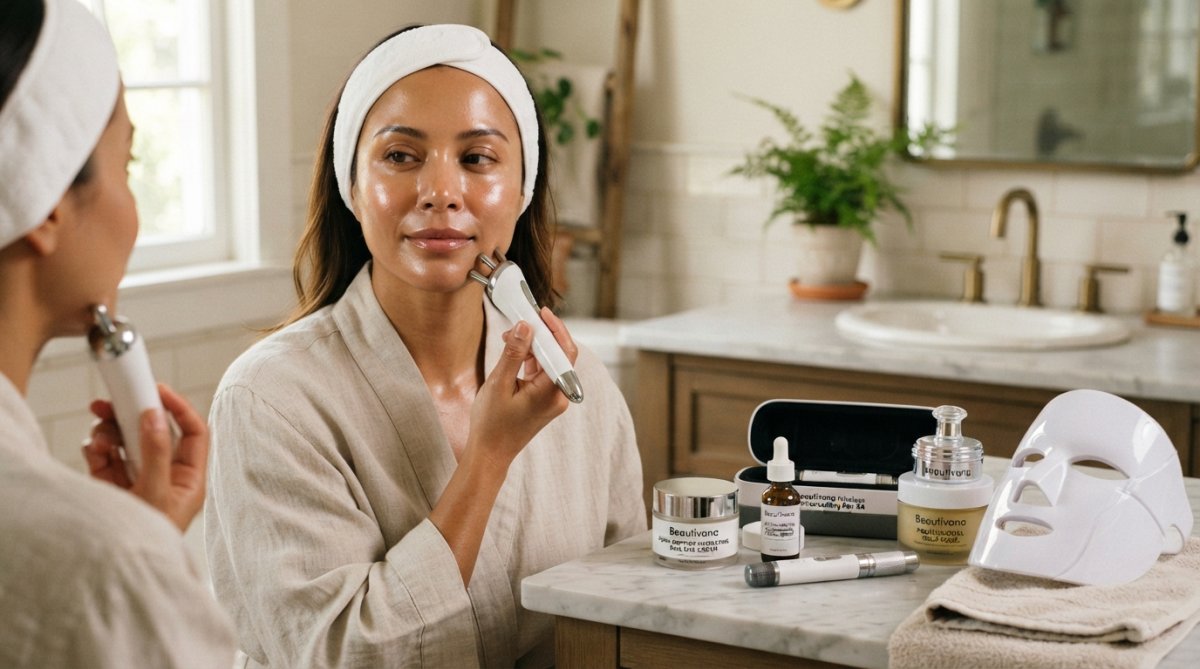
Microneedling creates controlled micro-injuries that trigger the skin's natural healing response, stimulating collagen and elastin production. The Beautivana Wireless Microneedling Pen Kit offers adjustable needle depths (0.25mm to 2.5mm), allowing customization based on skin condition and tolerance.
Microneedling works best paired with professional-grade serums because micro-channels created by needling enhance absorption dramatically. A vitamin C serum applied immediately after microneedling penetrates 10 times deeper than normal application. Most practitioners recommend microneedling 1-2 times monthly.
Ultrasonic devices use high-frequency vibrations to deep-clean pores, remove dead skin cells, and stimulate collagen production. The Beautivana Ultrasonic Skin Scrubber with EMS combines ultrasonic technology with EMS (electrical muscle stimulation) for dual benefits: deep cleansing plus muscle lifting.
A professional-grade skincare routine follows a specific sequence that maximizes absorption and efficacy. The order matters because different products have different molecular weights and pH levels.
Begin with a thorough cleanse that removes makeup, sunscreen, and environmental debris without stripping your skin. A double cleanse, oil-based cleanser followed by water-based cleanser, is most effective. Massage the cleanser into dry skin for 30-60 seconds, then add water and continue for another 30 seconds before rinsing thoroughly.
Apply serums while skin is still slightly damp to enhance absorption and reduce irritation. Apply in order of molecular weight, lightest first. Vitamin C serums go first, followed by peptide serums, then hyaluronic acid serums. Wait 1-2 minutes between products to allow absorption.
Integrate facial devices into your routine 2-3 times weekly, preferably in the evening. Microcurrent and RF devices can be used consecutively. Microneedling should be used separately, with a 1-week gap between microneedling and other device use.
Apply a conductive serum (hyaluronic acid or peptide serum) before using microcurrent or RF devices. After device use, apply a soothing serum or moisturizer to calm skin and support the healing response.
Complete your routine with a professional-grade moisturizer that complements your skin type. For morning routines, finish with broad-spectrum SPF 30 or higher sunscreen. Sun protection is non-negotiable with professional-grade skincare because many actives increase sun sensitivity.
| Step | Product Type | Duration | Frequency |
|---|---|---|---|
| Cleanse | Gentle cleanser | 2-3 minutes | Twice daily |
| Apply serums | Vitamin C, peptides, hyaluronic acid | 5-7 minutes | Daily |
| Device use | Microcurrent, RF, or microneedling | 10-15 minutes | 2-3x weekly |
| Moisturize & protect | Moisturizer + SPF (AM) | 2 minutes | Daily |
Professional-grade salicylic acid (2-3% concentration) penetrates pores deeply, dissolving sebum and preventing bacterial colonization. The Beautivana Ultrasonic Skin Scrubber with EMS complements salicylic acid treatment by deep-cleaning pores mechanically while EMS technology lifts and tightens surrounding tissue. Use the scrubber 2-3 times weekly, followed by salicylic acid serum and lightweight, non-comedogenic moisturizer. Acne-prone skin typically shows improvement within 2-3 weeks of consistent professional-grade treatment.
Fine lines develop as collagen and elastin break down with age and sun exposure. Professional-grade retinol increases cell turnover and stimulates new collagen production. Peptides amplify that production, while microcurrent mechanically lifts facial muscles that create dynamic wrinkles.
Start retinol at 0.3-0.5% concentration, using 2-3 times weekly initially, then gradually increasing frequency as skin builds tolerance. Pair retinol with a peptide serum applied before retinol to maximize collagen support. Use microcurrent devices 3-5 times weekly for anti-aging benefits. Most users see noticeable improvements in fine lines within 6-8 weeks, with more dramatic results after 12 weeks.
Professional-grade vitamin C (15-20% L-ascorbic acid) inhibits melanin production while brightening existing pigmentation. Professional-grade AHA exfoliants (8-15% glycolic acid) complement vitamin C by removing the outer layer of skin where hyperpigmentation concentrates. Use AHA 2-3 times weekly, followed by vitamin C serum and rich moisturizer. Results appear gradually over 8-12 weeks as skin naturally sheds pigmented cells, with dark spots fading by 30-50%.
A single professional facial costs $150-$300. A series of six facials costs $900-$1,800. Professional microneedling ranges from $200-$500 per session, with most people requiring 3-6 sessions.
A complete professional-grade skincare routine costs $200-$400 initially and $50-$100 monthly for maintenance. A quality at-home facial device costs $50-$200. Over one year, an at-home routine costs $800-$1,600 total, delivering equivalent or superior results to professional treatments costing $2,000-$3,000.
Most users see noticeable improvements within 4-6 weeks of consistent professional-grade skincare. Fine lines soften, skin tone evens, and texture improves. After 8-12 weeks, results become dramatic with significant reductions in fine lines, visible brightening, and improved skin firmness. After one year, you've spent $800-$1,600 and achieved results equivalent to $3,000-$5,000 in professional treatments.
Professional treatments and at-home routines are complementary. Many dermatologists recommend combining both approaches. Use professional-grade skincare at home consistently, then schedule professional treatments 4-6 times yearly for intensive boosts. A professional microneedling treatment followed by 6-8 weeks of at-home professional-grade skincare creates synergistic results. This hybrid approach costs significantly less than professional treatments alone while delivering superior results.
Professional-grade skincare is safe when used correctly, but higher potency means side effects are possible if precautions are ignored.
Retinization is the adjustment period when introducing retinol. Skin typically experiences increased cell turnover, manifesting as dryness, mild flaking, redness, and occasional breakouts. This is not an allergic reaction but your skin adapting to increased cell renewal. Retinization typically lasts 4-6 weeks.
Start with the lowest concentration (0.3%) and use 1-2 times weekly initially. Gradually increase frequency over 4-6 weeks as skin builds tolerance. Never apply retinol to damp skin; apply to completely dry skin and wait 20 minutes after cleansing.
Facial devices are safe when used as directed, but overuse causes irritation and temporary barrier damage. Microcurrent and RF devices should never be used more than 5 times weekly. Microneedling should be limited to 1-2 times monthly to allow adequate healing.
Never use microneedling on the same day as chemical exfoliants (AHA, BHA, or retinol). The combination causes excessive irritation and can damage the skin barrier. Wait at least 1 week between microneedling and RF device use. Always follow device instructions regarding treatment duration and intensity.
Professional grade skincare at home has transformed skin health possibilities without expensive, recurring professional treatments. The combination of clinical-strength products and advanced devices delivers measurable, lasting results with consistency and proper protocols. At Beautivana, we've assembled a curated collection of professional-grade serums, moisturizers, and innovative devices designed to help you achieve visible improvements in fine lines, firmness, and overall radiance. Your skin's transformation begins with the right tools and the commitment to use them correctly. Shop All Best Sellers and experience the professional-grade difference.
Professional grade skincare contains higher concentrations of active ingredients like retinol, vitamin C, and peptides, delivering clinical results. These products are formulated with science-backed ingredients at potencies strong enough to address specific skin concerns. Drugstore products typically contain lower active concentrations, offering general maintenance rather than targeted transformation. Professional-grade lines are often dermatologist-recommended and used by skincare professionals in medical spas.
Most users notice initial improvements in skin texture and hydration within 2-4 weeks of consistent use. However, visible results for anti-aging concerns like fine lines and wrinkles typically appear after 8-12 weeks of daily application. Results depend on your skin type, the specific active ingredients used, and adherence to a complete routine.
High-potency ingredients like retinol and AHA can cause irritation, redness, and sensitivity if not introduced gradually. Over-use of exfoliating acids or microneedling devices may damage the skin barrier. To minimize risks, start with low concentrations and always apply SPF 30+ during the day. Consult a dermatologist before using potent actives if you have sensitive skin or are pregnant.
At-home facial devices are clinically proven to deliver visible results when used consistently. Microcurrent devices stimulate facial muscles and collagen production, while microneedling pens create controlled micro-injuries that boost collagen and elastin production. At-home devices offer significant improvement in fine lines, puffiness, and skin texture but using professional treatments allows for deeper skin concerns.
At-home professional-grade skincare typically costs a fraction of regular in-office treatments. Investing in a curated at-home routine usually costs $300-$600 while delivering sustained, visible results. The best approach combines affordable at-home maintenance with occasional professional treatments for maximizing results and controlling costs.
[EXTERNAL_LINK: American Academy of Dermatology clinical guidelines on retinoid use | aad.org]
[EXTERNAL_LINK: Journal of Clinical and Aesthetic Dermatology study on professional-grade skincare efficacy | jcad.org]
[EXTERNAL_LINK: FDA guidance on cosmetic versus drug classification for skincare devices | fda.gov]
This article was written using GrandRanker