

Last Updated: September 10, 2026
Retinol alternatives for sensitive skin types exist because standard retinol is genuinely hard on reactive complexions. Retinol is a vitamin A derivative that accelerates cell turnover by binding to skin receptors, and that acceleration is exactly what triggers the stinging, flaking, and redness many people experience in the first weeks of use (peer-reviewed research). Fragile moisture barriers let irritants penetrate faster, so the same concentration that suits one person can leave another raw for days.
This guide breaks down which alternatives actually work, how to layer them, and where most people go wrong. If you have ever abandoned a retinol routine after three days of peeling, the problem was likely your barrier, not your willpower.
The best retinol alternatives for sensitive skin types fall into three groups: plant-based bakuchiol, barrier-repairing ceramides and peptides, and soothing actives like niacinamide and Centella Asiatica. Each supports firmness or texture through a different route, none require the tolerance-building period that retinol demands.
| Alternative | Mechanism of Action | Best For | Typical Use |
|---|---|---|---|
| Bakuchiol | Supports collagen signaling without receptor irritation | First-time anti-aging users | Evening serum |
| Ceramides and peptides | Rebuild the moisture barrier and support firmness | Dry, reactive, or compromised skin | AM and PM moisturizer |
| Niacinamide | Regulates oil, calms redness, supports barrier lipids | Oily yet sensitive skin | Serum or mist |
| Centella Asiatica | Soothes visible irritation and supports comfort | Post-reaction recovery | Ampoule or cream |
The key insight: these ingredients do not need to be rotated in slowly the way retinol does. You can usually start them at full strength from day one.
Bakuchiol is a plant-derived compound extracted from the seeds of the Psoralea corylifolia plant (PubMed). It supports collagen production through pathways that do not involve the retinoic acid receptors responsible for most retinol irritation, which is why it rarely causes the peeling and stinging that send sensitive-skin users running.
What most guides miss is that bakuchiol is not simply "retinol but weaker." It works differently. Users typically report improved firmness and a smoother feel over several weeks rather than the dramatic shedding phase retinol produces. Apply it in the evening after cleansing, then follow with a barrier moisturizer.
Ceramides are lipids that make up a significant portion of the skin's outer barrier, and peptides are short chains of amino acids that support the skin's own structural proteins. Together they take a repair-first approach: strengthen the barrier, reduce moisture loss, and let the skin do its own work.
For reactive skin, this is often the smarter starting point than any active. A compromised barrier makes every other ingredient feel irritating, so a ceramide-rich moisturizer applied morning and evening can make the difference between a routine that works and one that fails. Look for formulas that pair ceramides with panthenol and hyaluronic acid, which draw in and hold moisture while the barrier rebuilds.

Niacinamide is a form of vitamin B3 that helps regulate oil production and supports the barrier's lipid structure, and Centella Asiatica is a botanical long used in Korean skincare for its calming properties. Both are well tolerated by most reactive skin types when introduced at moderate concentrations.
These two work best as supporting players rather than headline actives. A hydrating mist featuring panthenol, Centella, niacinamide, and squalane can be layered between cleansing and serum to calm the skin before the rest of your routine goes on. If your skin reacts to almost everything, start here before adding anything stronger.
The main bakuchiol benefit for sensitive skin is that it delivers visible firmness support without the receptor-level irritation retinol causes. That single difference changes everything for reactive complexions: no tolerance-building phase, no predictable week-two flake, no need to buffer with three layers of moisturizer before applying.
A common mistake is expecting bakuchiol to behave like a fast-acting retinol. It will not resurface your skin in two weeks. What it does offer is steady, cumulative improvement in how firm and smooth your skin feels, with a far lower chance of a reaction. In practice, that means you can actually stay consistent, and consistency is what produces results with any active.
Learning how to improve skin texture at home comes down to three levers: gentle exfoliation, consistent hydration, and patience with a routine you can actually maintain. Texture rarely improves from one hero product. It improves when the barrier stays intact long enough for turnover to normalize.
Start with cleansing. A water-activated powder cleanser lets you control the intensity: use more water for a gentler wash, less for a light exfoliating pass. Enzyme-based powders lift surface buildup without the abrasiveness of a physical scrub, which matters when your skin flushes easily.
Hydration is the second lever. Layering a milky ceramide serum under a ceramide moisturizer keeps moisture in and irritants out. The third lever is time. Most people quit a texture routine at week three, right before the visible change would have appeared.

A skincare routine for reactive skin should be short, fragrance-light, and built around barrier support rather than active stacking. The goal is to give your skin a predictable sequence it can tolerate every single day, not a rotating menu of new ingredients.
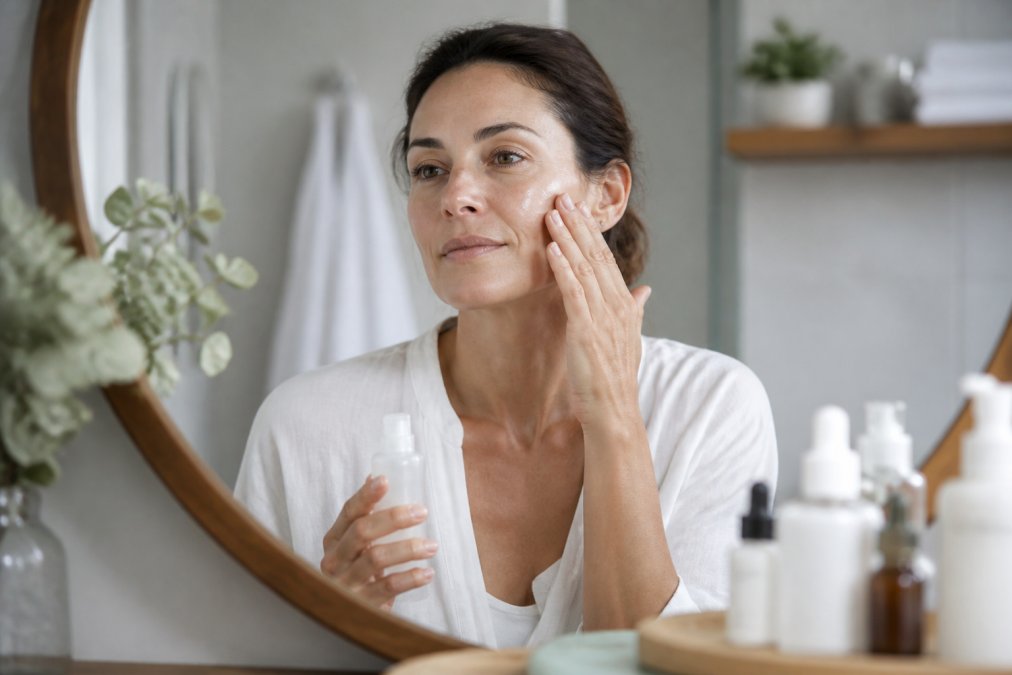
A reliable structure looks like this:
Notice there is no acid toner and no retinol in that list. For reactive skin, those are optional additions you earn later, not baseline steps. If your skin is calm for a few weeks, you can consider adding one active back in.
Layering retinol alternatives with your current products is easier than layering retinol, because none of these ingredients require the same caution around acids and vitamin C. The general rule is thinnest to thickest: mist, then serum, then ampoule, then moisturizer.
If you use a vitamin C toner pad in the morning, apply it after cleansing and before your serum. Vitamin C and niacinamide are compatible in modern formulations, so a toner pad followed by a hydrating mist and moisturizer is a sound morning sequence. In the evening, swap the vitamin C step for bakuchiol and finish with your ceramide moisturizer.

One thing to watch: if you are transitioning off retinol, do not add bakuchiol the very next night. Give your barrier a week or two of pure hydration first. Jumping straight from one active to another is how people end up convinced their skin "can't handle anything."
The biggest mistake when switching from retinol is treating the switch as a lateral move and applying the new active with the same frequency and intensity. Your barrier is likely compromised from the retinol you just stopped, so it needs recovery time before it needs another active.
Other mistakes that show up again and again:
The American Academy of Dermatology's guidance on sensitive skin care consistently emphasizes gentle cleansing and daily sunscreen as the foundation for reactive complexions, which lines up with what most people discover the hard way.
Switching away from retinol does not mean giving up on firmer, smoother skin. It means choosing ingredients your barrier can tolerate long enough to see results. Beautivana carries a curated range built for exactly this: the Beautivana Milky Ceramide Face Serum for lightweight barrier support, the Beautivana Ceramide Skin Barrier Moisturizer to seal in moisture, and the Beautivana Panthenol + Centella Hydrating Mist for a calming layer between steps. Customers can build a full reactive-skin routine from these three products alone, with fast U.S. shipping and authentic K-beauty formulas. Shop All Best Sellers and start with the barrier, not the active.
Bakuchiol is the most studied plant-based retinol alternative for sensitive skin. It works on similar collagen-supporting pathways but without the peeling and redness retinol often causes. Ceramides and peptides are strong supporting options: they rebuild the moisture barrier so skin tolerates active ingredients better over time. Many people with sensitive skin do best combining bakuchiol with a barrier moisturizer rather than relying on one ingredient alone.
Bakuchiol has shown comparable improvements in fine lines and firmness to retinol in published comparison studies, but with far less irritation. The trade-off is speed: retinol often produces visible change faster, while bakuchiol works more gradually. For sensitive skin that cannot tolerate retinol at all, bakuchiol's gentler profile means you can actually use it consistently, and consistency matters more than potency for long-term results.
Some people with sensitive skin can build tolerance to low-strength retinol by starting once a week and buffering with moisturizer, but many cannot. If you have tried retinol at 0.1% or lower and still experience burning, flaking or persistent redness, your skin is telling you something. Retinol alternatives like bakuchiol and ceramide-based formulas let you pursue anti-aging goals without repeatedly triggering your barrier.
Watch for high-percentage retinol, glycolic and lactic acids above 5%, fragrance, essential oils, denatured alcohol and physical scrubs with rough particles. These strip the barrier and trigger reactivity. Instead, look for bakuchiol, ceramides, panthenol, Centella Asiatica, niacinamide and hyaluronic acid. A gentle enzyme powder cleanser used two or three times a week gives exfoliation without the abrasion that leaves reactive skin red and tight.
Start with a gentle cleanser, then apply a hydrating serum or ampoule. Follow with your retinol alternative, such as a bakuchiol product, and seal everything with a ceramide moisturizer. Use it at night three times a week for the first two weeks, then increase if your skin stays calm. Always finish daytime routines with sunscreen, since anti-aging ingredients work best when UV damage is controlled.